Chapter 9 of 11 · ASF Breeding Guide
Feeding ASF to snakes
Disclaimer: I'm not a veterinarian and I don't hold a degree in animal science or animal care. This is a guide I compiled for raising feeder rodents for my own snakes. Follow your local laws, and ask a vet about sick animals.
The short version
- Pick a feeder that weighs about 10–15% of what your snake weighs and is no wider than the widest part of the snake.
- ASF sizes vary from line to line. Weigh your own and write the real grams on each bag.
- Nobody knows for sure why some ball pythons like ASF, and nobody has tested what nutrition ASF have.
- Some snakes that start on ASF won't take rats or mice later. Many breeders start baby snakes on rats and save ASF for picky eaters.
- To switch a snake back to rats, keepers make the rat smell like ASF, swap in a rat right after a strike, use a smaller rat at first, and stay patient.
Sizes by age (estimates)
| Age | Approximate weight | Source |
|---|---|---|
| Birth | 2.1–2.4 g | [1][2] |
| About 1 week | about 4–7 g | [2] |
| About 2 weeks | about 8–10 g | [2] |
| About 3 weeks (weaning) | about 10–12.5 g | [2] |
| About 1 month | about 18 g | [3] (hobby) |
| 40 days | males 34 g, females 29 g | [1] |
| 90 days | males 78 g, females 54 g | [1] |
| 4 months (feeder line) | females 60 g, males 75 g | [3] (hobby) |
| Adult feeder-line males | up to about 140 g | [3] (hobby) |
Lab numbers exist from birth to weaning, then at 40 and 90 days. In one study, pups of mothers on low-protein food were lighter [2]. Feeder lines vary, so weigh your own and label bags by actual grams.
Matching prey to snake: use the same rule as for rats and mice. The feeder should weigh about 10–15% of what the snake weighs, and be no wider than the widest part of the snake's body (see Feeding).
What's known about ASF as food
- Why some ball pythons prefer them: unknown. Some keepers think ball pythons know ASF as African food. That's only an opinion [4]. Wild ball python diet studies record African rodents, including Tullberg's soft-furred mouse (Praomys tullbergi), a close relative of ASF but not ASF itself [5].
- Nutrition: no published analysis of ASF exists. Whole-prey studies cover mice and rats [6]; keepers assume ASF are similar.
Snakes that won't eat anything else
Some snakes that start on ASF refuse rats and mice afterward. One keeper's female ate only ASF for several months [7]. Because ASF can be hard to find, many breeders start hatchlings on rats and keep ASF for problem feeders.
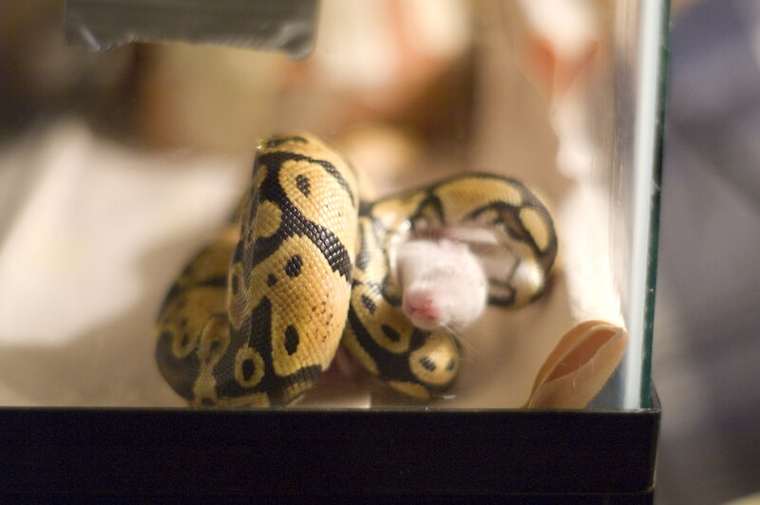
Switching back (keeper methods, no study):
- Scenting: warm up a rat or mouse and rub it with used ASF bedding. Or seal it in a bag with the bedding for 15–30 minutes. Over the next several feedings, use less and less scent [4][8].
- The swap: offer an ASF, and right after a good strike follow it with a rat of the same size.
- Size down the rat at first.
- Patience: one keeper's snake took rats that had sat in ASF bedding for a few hours, and in time took plain rats [7].
Step by step: switching back to rats
These are keeper methods. No study has tested them.
- Start with a rat that is a bit smaller than usual.
- Warm the rat. Rub it with used ASF bedding, or seal it in a bag with the bedding for 15–30 minutes.
- Offer it to the snake.
- If the snake won't take it, try the swap: offer an ASF, and right after a good strike, follow it with a rat of the same size.
- Over several feedings, use less and less scent.
- Be patient. One keeper's snake took rats that had sat in ASF bedding for a few hours, and in time took plain rats.
Sources for this chapter
- Kagira, J. M. et al. (2005), Scandinavian Journal of Laboratory Animal Science, PDF
- Lamb, C. E., maternal protein intake and pup development in Mastomys, MSc dissertation, University of Pretoria, repository record (published as Lamb and van Aarde 2001, Journal of Zoology, on M. coucha)
- ASF Breeding Hub, ASF Care File v1.2 (hobby, 2021)
- FurryCritter, African soft-furred rats (hobby site)
- Cosquieri, F., Busting royal python myths, summarizing Luiselli and Angelici (1998)
- Dierenfeld, E. S., Alcorn, H. L. and Jacobsen, K. L. (2002), Nutrient composition of whole vertebrate prey (excluding fish) fed in zoos, USDA National Agricultural Library, Internet Archive
- MorphMarket Community, African soft-furred rats experience (keeper forum)
- FurryCritter, Scenting prey (hobby site)