Chapter 4 of 11 · ASF Breeding Guide
Food and water
Disclaimer: I'm not a veterinarian and I don't hold a degree in animal science or animal care. This is a guide I compiled for raising feeder rodents for my own snakes. Follow your local laws, and ask a vet about sick animals.
The short version
- Feed lab rodent block (hard food pellets). Keep some in the cage all the time.
- Mothers with babies need protein most. A mother who doesn't get enough protein is more likely to eat her babies.
- Small treats like a little boiled egg or a few mealworms are fine for mothers. The block is still the main food.
- Every cage needs water every day. A nursing mother without water can't keep feeding her litter.
- Check bottles for drips every day. A leak soaks the nest and chills the babies.
Food
- Lab rodent block, free-fed. The NIH colony fed an 18% protein lab diet with unlimited access [1]. Hobby breeders say breeding animals need food with at least 20% protein and no more than 10% fat. Animals that aren't breeding need at least 15% protein. They also warn that much more than 20% protein may strain the kidneys over time [2].
- Mothers need protein most. A protein-short mother is more likely to eat her pups (breeder experience).
- Extras in small amounts: a little boiled egg, a few mealworms or seeds for nursing mothers. Lab colonies have added vegetables and nuts [3]. Never enough to replace the block.
- There's no published figure for how much an ASF eats per day. Weigh the block you use each month to learn your colony's rate.
Our plan: a breeder-formula lab block (20% protein or more) always available, plus a small protein treat for mothers with litters.
Daniel's experience (hobby): diet is the thing that makes or breaks a colony. On the wrong food he saw poor production, die-offs and mothers eating litter after litter. Get the block right before anything else. In his experience most mouse and ASF breeders feed a 23% protein block and ASF struggle on less; rat breeders usually run 18%. Brands differ (Mazuri, Kalmbach, Kent are all "rodent block" and all different). On dog food as an extra, his view is that the real problem is red dye 40, not dog food as such.
Water
- Every cage, every day. Check every bottle daily. A nursing mother without water can't keep feeding her litter.
- Bottles: ASF chew bottle caps (breeder experience). Check for drips daily; a leak soaks the nest and chills the pups.
- Lab racks use automatic watering. But if a valve gets stuck open, it floods the cage and the babies can drown. Only trust it after the system has been tested for leaks under full pressure, and check it every day.
- The NIH colony used reverse-osmosis water [1]; clean tap water is what most keepers use.
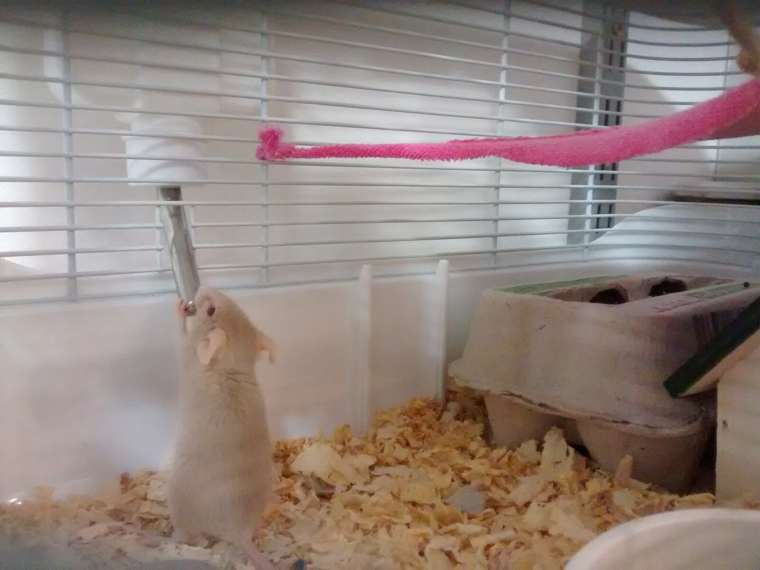
Step by step: the daily food and water check
- Look at every bottle. Each cage needs water every day.
- Check each bottle for drips, and check the caps for chewing.
- If you use automatic watering, check it every day for a stuck valve or a flooded cage.
- Make sure there's block in every hopper.
- Once a month, weigh the block you used. Over time this tells you how much your colony eats.
Sources for this chapter
- Safronetz, D. et al. (2021), Viruses, PMC8065687
- ASF Breeding Hub, ASF Care File v1.2 (hobby, 2021)
- Kagira, J. M. et al. (2005), Scandinavian Journal of Laboratory Animal Science, PDF