Chapter 6 of 11 · ASF Breeding Guide
Running a colony
Disclaimer: I'm not a veterinarian and I don't hold a degree in animal science or animal care. This is a guide I compiled for raising feeder rodents for my own snakes. Follow your local laws, and ask a vet about sick animals.
The short version
- Every day: check water, food and every breeding cage. Write new litters on the cage card.
- Every week: move 21-day-old babies to their own cage, weigh some, cull (humanely kill) and freeze feeders, change cages, and update your records.
- Keep a card on every breeding cage and a log with one line for each litter.
- Retire a breeder after about 8 litters, at about 1 year of age, or when her litters get small or stop.
- Pair animals from different lines so they aren't close family. Hold ASF by the base of the tail, wear gloves, and work over a tub.
- Breed only from calm animals and freeze the biters: temperament is partly inherited, and a colony gets calmer over generations.
Every day
- Water in every cage; bottles not dripping.
- Food in every hopper.
- A look in every breeding cage: a new litter, a dead animal, wounds from fighting, a gap someone could escape through.
- New litters written on the cage card.
Once a week
- Wean litters that are about 21 days old and sort them by sex. Wean earlier only if the pups are already eating solid food (see The breeding cycle).
- Weigh a sample of each size group.
- Cull and freeze what's going into the freezer (see Humane euthanasia and freezing).
- Change cages.
- Update the records.
A week in the rodent room
The whole routine on one screen. Every job here comes from this chapter.
| When | Job | Which cages |
|---|---|---|
| Every day | Water in, no drips | Every cage |
| Every day | Food in the hopper | Every cage |
| Every day | Look for a new litter, a dead animal, fight wounds, escape gaps | Breeding cages |
| Every day | Write new litters on the card | Breeding cages |
| Once a week | Wean litters at about 21 days, sort by sex | Cages with litters |
| Once a week | Weigh a sample of each size | Weaned young |
| Once a week | Cull and freeze | Feeders going into the freezer |
| Once a week | Change cages, update cards and log | Every cage |
| Every month | Start a new pair or two | New cages |
| Every month | Read the log: who produced, who missed | Breeding cages |
| At 4–5 weeks old | Check sex again before they can breed | Weaned young |
Records
Cage cards are the lab standard [1][2]. Each breeding cage gets: cage number, line, sire and dam IDs with birth dates, date paired, and for every litter the birth date, number born, number weaned and weaning date.
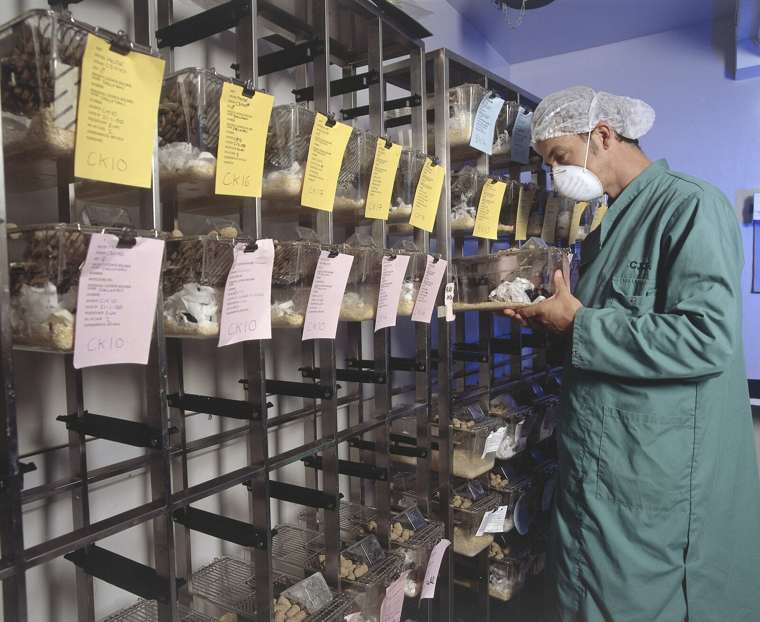
A colony log is a list with one row for each litter. Each month it shows which females are having litters, which missed a litter, and how many pups each cage weans.
Step by step: filling in a cage card
- Write the cage number and the line.
- Write the sire's and dam's IDs and their birth dates.
- Write the date they were paired.
- For every litter, add:
- the birth date;
- the number born;
- the number weaned;
- the weaning date.
- Copy each litter into the colony log as its own row.
Retiring breeders
Retire a breeder at whichever comes first:
- about 8 litters: a lab colony retired breeders after weaning their 8th litter [3];
- about 1 year of age: a hobby care sheet says older females have more problems and smaller litters [4];
- a clear drop in litter size, or no litter in 6–8 weeks from a pair that has had litters before (new pairs can take up to 8 weeks just to mate [5]).
The research disagrees on age: one colony saw litter size fall as females aged [3], another didn't [5].
Replacements and inbreeding
Keep the biggest, calmest pups from your best-producing cages as the next breeders, and start a new pair or two every month so retirements never come all at once.
Cross your lines. Pair line A males with line B females and the reverse; with three lines, rotate them. No study has tested this on Mastomys, but it's the normal way farm animals are bred. Breeding close relatives won't kill your colony right away. One lab colony bred brothers to sisters on purpose [3]. But over many generations, it tends to make litters smaller and animals weaker.
Keep the colony closed. Adding "new blood" from outside without quarantine is how diseases and parasites get in (see Health and safety).
Breeding for temperament
ASF are nervous and will bite [7], but how nervous and how bitey is partly inherited, and a colony can be bred calmer over time. The evidence comes from rats and mice, not from Mastomys, so treat it as a strong lead rather than a proven recipe for ASF.
- Temperament is heritable and responds to selection. Wild rats selected over generations for tolerating a gloved hand versus attacking it split into a tame line and an aggressive line; cross-fostering pups between the lines showed the difference was not learned from the mother [9]. In wild house mice, selecting the males that attacked fastest raised that trait with a realized heritability of about 0.30 over 11 generations, a moderate figure typical of behaviour [10]. Moderate heritability means selection works, but it takes generations, not one cull.
- Feeder and pet rat breeders do this on purpose. One large feeder breeder puts it bluntly: cull hard, selection is a powerful tool, and no rat in their racks bites (hobby) [11]. A pet rat breeder never breeds from an animal that has bitten a person or is rough with cage mates, even once, and picks the calmest males to use most (hobby) [12].
- Separate fear from aggression. Much "meanness" in rodents is fear. Lab mice picked up by the tail stay anxious; mice moved with a tunnel or a cupped hand approach the handler and test calmer after only days of handling [13]. Settle on one calm way of moving them (see Handling) before you judge any animal, or you will cull the frightened and keep the frightening.
- A mother defending a new litter is normal, not a temperament fault. Judge mothers on how they are between litters.
How to run it:
- Note temperament on the cage card at every weaning, in one word: calm, nervous, biter.
- Never breed from an animal that has bitten a person through normal handling, or that wounds cage mates. It goes to the freezer with the next cull, by the humane method, the same as any other feeder.
- Pick next season's breeders from the calmest pups of the calmest, best-producing cages, not just the biggest.
- Don't cull so hard that one or two cages supply every replacement; keep your lines so the colony stays healthy (see Replacements and inbreeding above).
- Expect change over several generations. No one has measured how fast this works in ASF, so write down what you see and let the cards tell you.
Sexing
As in mice, the gap between the anus and the genital opening is longer in males [6]. As they grow, females show rows of nipples and adult males have visible testes. Sex pups at weaning and check again at 4–5 weeks, before they can breed.
Handling
ASF are nervous, fast and bite. One study called them the "most nervous species" it handled [7]; the NIH colony used bite-proof Kevlar gloves and light sedation for cage changes [5].
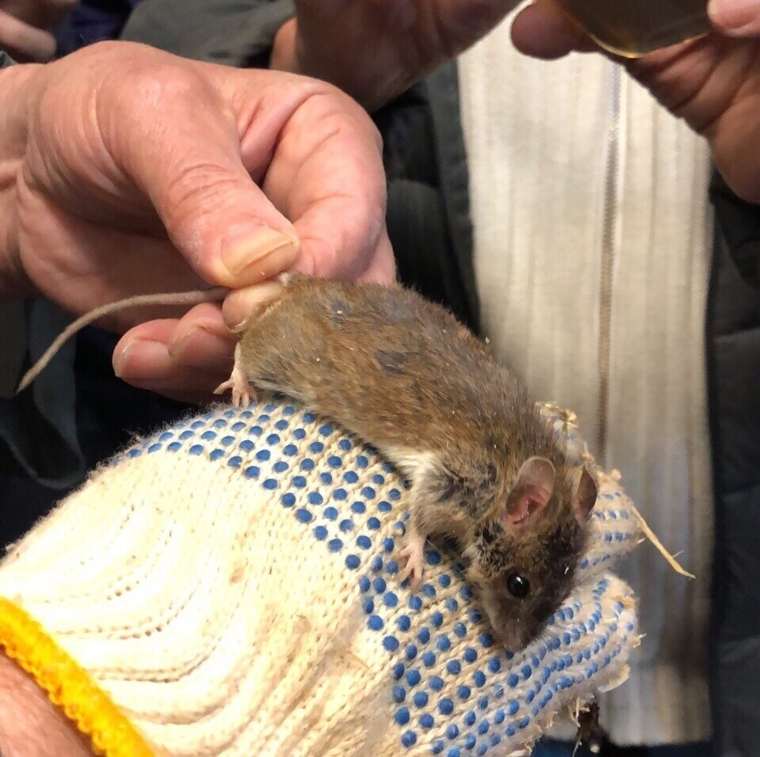
- Hold by the base of the tail, never the tip; tail skin can strip off [4][8]. Support the body for anything longer than a moment.
- Wear gloves.
- Work over a tub, with the room door closed.
- Keep handling around nests short and calm.
Sources for this chapter
- West Virginia University, Breeding and weaning of rats and mice
- Texas A&M University, Guidelines on laboratory rodent breeding and weaning
- Kagira, J. M. et al. (2005), Scandinavian Journal of Laboratory Animal Science, PDF
- ASF Breeding Hub, ASF Care File v1.2 (hobby, 2021)
- Safronetz, D. et al. (2021), Viruses, PMC8065687
- Queen's University, Breeding and weaning mice SOP
- Choate, T. S. (1972), Zoologica Africana, PDF
- Queen's University, Manual restraint of mice SOP
- Albert, F. W. et al. (2008), rats selected for tameness and for defensive aggression towards humans, Hormones and Behavior 53: 413–421, PubMed 18177873
- van Oortmerssen, G. A. and Bakker, T. C. M. (1981), artificial selection for short and long attack latencies in wild house mice, Behavior Genetics 11: 115–126, doi:10.1007/BF01065622
- MorphMarket Community, Some rodent breeding tips (feeder breeder thread)
- Blue Apple Rats (pet rat breeder, 2025), When I say I breed for temperament (hobby)
- Hurst, J. L. and West, R. S. (2010), taming anxiety in laboratory mice, Nature Methods 7: 825–826, doi:10.1038/nmeth.1500