Chapter 3 of 11 · ASF Breeding Guide
Housing
Disclaimer: I'm not a veterinarian and I don't hold a degree in animal science or animal care. This is a guide I compiled for raising feeder rodents for my own snakes. Follow your local laws, and ask a vet about sick animals.
The short version
- Keep the rodents in a different room from your snakes, with their own tools and gloves.
- Keep the room between 68 and 79 °F (20–26 °C), with lights on a timer: 12 hours on, 12 hours off. Use a fan for fresh air. A strong pee smell (ammonia) means you need more air or more cleaning.
- Use cages or tubs with tight lids and mesh no wider than ¼ in. ASF jump, and babies squeeze through gaps.
- Use aspen or paper bedding, never cedar. Put paper for a nest in every breeding cage.
- Change cages every week. Leave new babies alone for the first few days.
The room
- Separate from the snakes, with its own tools and gloves. Rodent mites and germs travel on hands and equipment.
- Temperature: 68–79 °F (20–26 °C), the lab standard for mice and rats [1]; the NIH Mastomys colony ran at 22 ± 2 °C (about 68–75 °F) [2]. Breeding slows when it's cold.
- Humidity: 30–70% [1]; 40–60% in the NIH colony [2].
- Light: 12 hours on, 12 off, on a timer [2].
- Air: labs change the room air 10–15 times an hour [3]. At home that means an exhaust fan and never a closed closet. A strong ammonia smell means more air or more frequent cage changes.
Floor space
There's no published space standard for Mastomys. The lab standards for mice and rats bracket them [4]:
| Animal | Floor space |
|---|---|
| Mouse over 25 g | 15 sq in each |
| Mouse female with litter | 51 sq in |
| Rat under 100 g | 17 sq in each |
| Rat female with litter | 124 sq in |
Hobby breeders allow about 0.45–0.55 sq ft (65–80 sq in) per adult for groups of five or fewer [5].
What that means in practice:
- A breeding pair with her litter needs about 130–165 sq in. Two lab colonies kept pairs in cages of about 163 sq in [7][8], and the hobby figure works out to about 130–160 sq in for two adults [5]. Wean on time so the cage doesn't fill up.
- A group of one male and two females needs roughly 200 sq in or more.
- A group of one male and three females needs roughly 260–320 sq in.
Daniel's experience (hobby): he ran his main production in Vision V-35 tubs (about 200 sq in of floor) on five 8-high racks and found them the best size he tried. He also used lab cages, Freedom Breeder Series 10 tubs and ARS 50-series tubs for holding and grow-outs, and a 7-high Vision 70 rack. His warning about big tubs: the larger the tub, the larger the group it needs, and even then it produces less per tub, not more. He kept groups small and weaned on time. That is below the per-animal figures above, and it is what our plan follows. He also tried ARS 20-series racks and sold them on: good for holding and grow-outs, not production. His custom racks used screen lids; Vision also sells a tub lid for the V-35 that he found works well, and once you do the math it costs about what a rack does.
Cages and tubs
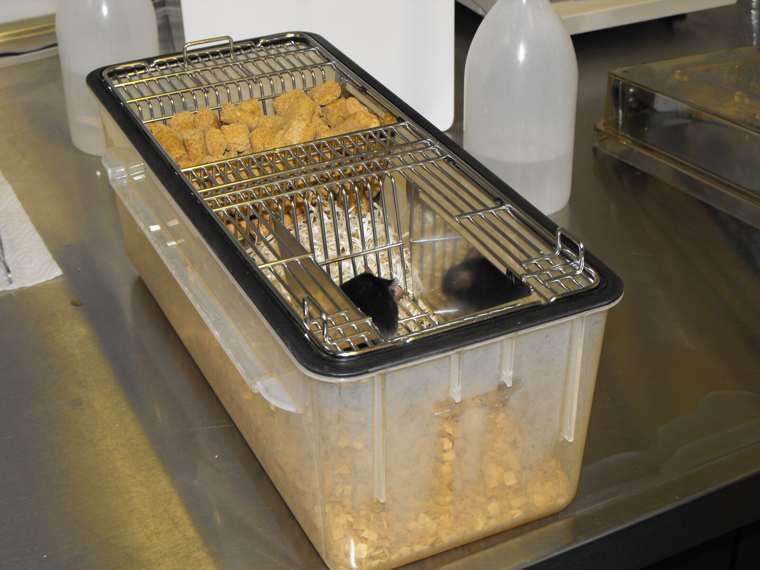
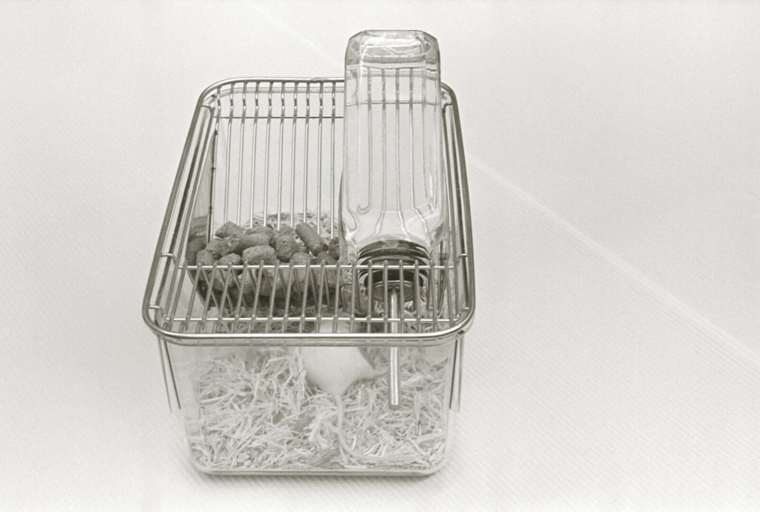
- Lab rodent cages (polycarbonate or polysulfone, wire lid with food hopper and bottle holder) are made for this and wash well.
- Plastic storage tubs work for groups if the walls are smooth and the lid is mesh.
- Height: at least 6 in inside.
- Chewing: ASF chew plastic edges; cover any chewed edge with aluminum flashing.
Lids and escapes
ASF are fast, agile and jump. The NIH team sealed their whole room to stop escapes [2]. Lids must seat tightly, with mesh no wider than ¼ in [5], or pups will squeeze through. Do cage changes over a tub or bathtub, never over open floor.
Bedding and nests
- Aspen or other hardwood chips, or paper bedding. The lab standard says not to use untreated softwoods (wood from trees like pine and cedar). Cedar gives off fumes that affect the liver [6]. Many hobby breeders use kiln-dried pine (pine dried with heat). They say paper bedding does a poor job of holding in the ammonia smell [5]. So the lab and hobby sources disagree here.
- Nesting: paper strips or a small hut in every breeding cage. The NIH colony used paper nesting material and shelters [2].
- Chew items: an untreated wood block or cardboard.
Our plan: aspen, never cedar; shredded paper for nests.
Cage changes
- A full change weekly [3]. Labs stretch this to every 2 weeks only for cages that each get their own fan-driven, filtered air [3]; a hobby tub rack isn't one of those. Spot-clean wet corners in between if it smells.
- Leave new nests alone for the first few days unless something is wrong. Parents killing newborns has been linked to handling and disturbance [7].
Step by step: a cage change
- Look for a new litter. If the nest is only a few days old, leave that cage alone unless something is wrong.
- Put on your rodent-room gloves. Use rodent-room tools only.
- Work over a tub or bathtub, never over open floor.
- Move the animals into a clean cage with fresh aspen or paper bedding.
- Add paper nesting strips or a small hut to every breeding cage, and a chew item.
- Check the cage edges. Cover any chewed plastic edge with aluminum flashing.
- Seat the lid tightly before you walk away.
- Between full changes, spot-clean wet corners if the cage smells.
Sources for this chapter
- UCLA Animal Research Committee, citing the Guide for the Care and Use of Laboratory Animals, Temperature and humidity
- Safronetz, D. et al. (2021), Viruses, PMC8065687
- UC Davis, Husbandry care of lab mice and rats (policy SC-31-100)
- Guide for the Care and Use of Laboratory Animals, 8th ed., space table via Wayne State IACUC
- ASF Breeding Hub, ASF Care File v1.2 (hobby, 2021)
- UCLA Animal Research Committee, Bedding
- Baker, C. M. and Meester, J. (1977), postnatal development of Mastomys, Zeitschrift für Säugetierkunde, PDF
- Lamb, C. E., MSc dissertation, University of Pretoria, handle