Chapter 8 of 11 · ASF Breeding Guide
Humane euthanasia and freezing
Disclaimer: I'm not a veterinarian and I don't hold a degree in animal science or animal care. This is a guide I compiled for raising feeder rodents for my own snakes. Follow your local laws, and ask a vet about sick animals.
The short version
- Breeding feeders means ending lives, and it should be done quickly and humanely. This chapter follows the AVMA euthanasia guidelines (2020 edition). If you're unsure about any of it, ask a vet to show you.
- For adult rodents, the AVMA method is CO2 from a cylinder, through a regulator and a flowmeter. CO2 from dry ice is not acceptable, and home-made CO2 doesn't meet the AVMA standard either. Start with the chamber at room air, then turn on the gas. Keep the gas flowing for at least 1 minute after breathing stops.
- Newborn rodents resist CO2. For pinkies and fuzzies, use long CO2 exposure, followed by a physical method once the pup no longer responds to a toe pinch. Cooling is never a method on its own, and pups must never touch ice or a pre-chilled surface.
- Check several signs together to confirm death: no breathing, no heartbeat, no blink when the corner of the eye is touched, and no response to a firm toe pinch. If you're not sure, put the animal back in the CO2 or use a physical method.
- Never freeze a live animal. Nothing goes in the freezer until it is dead.
Why this chapter is here
Breeding feeders means ending lives, and it should be done quickly and humanely. The standard reference is the American Veterinary Medical Association's euthanasia guidelines (2020 edition) [1]. If you're unsure about any of this, ask a vet to show you.
Carbon dioxide (CO2)
For adult rodents, the AVMA method is CO2 from a cylinder, through a regulator and a flowmeter [1]:
- Bottled CO2 only. CO2 from dry ice is not acceptable [1][2]. Home-made CO2 (like baking soda and vinegar) can't give a measured, steady flow, so it doesn't meet the AVMA standard either [1].
- Flow rate: every minute, the gas should replace 30% to 70% of the chamber's volume (the amount of air the chamber holds). For a 20-liter chamber that's 6–14 liters a minute, so you need a flowmeter, not just a pressure gauge.
- Start with the chamber at room air, then turn on the gas. The AVMA says putting an awake rodent straight into a chamber already full of CO2 is unacceptable, because breathing strong CO2 hurts [1]. University policies ban pre-filled chambers too [2].
- Keep the gas flowing for at least 1 minute after breathing stops [1].
- Don't crowd the chamber. Every animal should be able to stand on the floor.
- Use a clear chamber so you can watch. It needs one small outlet so the air pushed out by the gas can escape, and no other gaps [1].
Newborn and young pups
Newborn rodents resist CO2. The AVMA notes newborn mice can take up to 50 minutes to die in CO2, and newborn rats up to 35. It also notes that their pain pathways (the nerve paths that carry pain signals) aren't well developed until about day 5–7 [1]. By 10 days old, 5 minutes was enough. ASF pups haven't been tested, so treat them like mouse and rat pups [1]. For pinkies and fuzzies:
- use long CO2 exposure, followed by a physical method (cervical dislocation or decapitation) once the pup no longer responds to a toe pinch [1];
- cooling is never a method on its own. The AVMA allows slow cooling of pups up to about 10 days old only as a first step. The pups must never touch ice or a pre-chilled surface, and a physical method must follow once they stop moving [1][2]. Past about 10 days, cooling isn't acceptable at all [1].
Confirming death
Check several signs together: no breathing, no heartbeat, no blink when the corner of the eye is touched, and no response to a firm toe pinch. The AVMA says no single sign except rigor mortis (the body going stiff) proves death on its own [1]. If you're not sure, put the animal back in the CO2 or use a physical method. Never freeze one you're unsure about [1][2].
Never freeze a live animal
For rodents, the only freezing the AVMA accepts as euthanasia is rapid freezing in liquid nitrogen, for pups under 5 days old. Liquid nitrogen is dangerous to handle and isn't a home method. In every other case the animal must be dead before it goes into a freezer [1]. A home freezer is never a method.
CO2 checklist
- For adult rodents, use CO2 from a cylinder, through a regulator and a flowmeter. Bottled CO2 only: CO2 from dry ice is not acceptable, and home-made CO2 doesn't meet the AVMA standard either.
- Use a clear chamber so you can watch. It needs one small outlet so the air pushed out by the gas can escape, and no other gaps.
- Start with the chamber at room air, then turn on the gas. Putting an awake rodent straight into a chamber already full of CO2 is unacceptable.
- Don't crowd the chamber. Every animal should be able to stand on the floor.
- Set the flow so that every minute the gas replaces 30% to 70% of the chamber's volume. For a 20-liter chamber that's 6–14 liters a minute.
- Keep the gas flowing for at least 1 minute after breathing stops.
- For pinkies and fuzzies: use long CO2 exposure, followed by a physical method (cervical dislocation or decapitation) once the pup no longer responds to a toe pinch. Cooling is never a method on its own, and pups must never touch ice or a pre-chilled surface.
- Confirm death. Check several signs together: no breathing, no heartbeat, no blink when the corner of the eye is touched, and no response to a firm toe pinch. If you're not sure, put the animal back in the CO2 or use a physical method.
- Only then freeze. The animal must be dead before it goes into a freezer. Never freeze one you're unsure about. A home freezer is never a method.
Freezing and packaging feeders
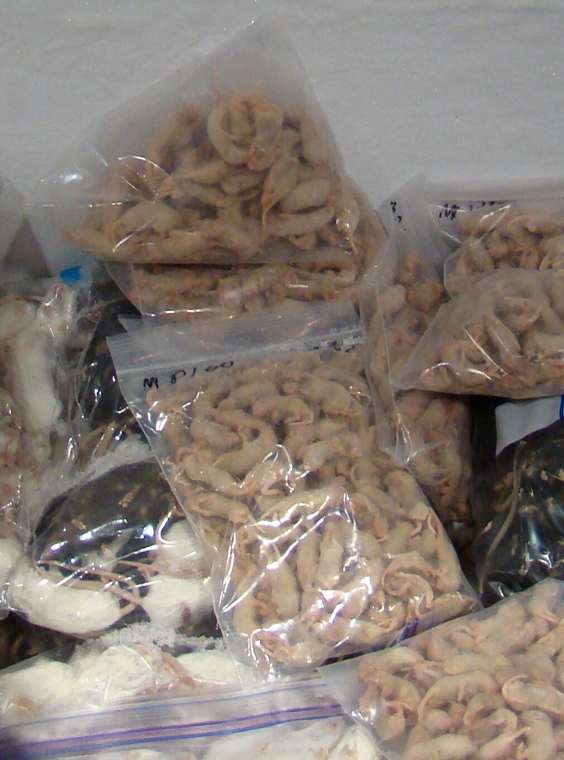
- Freeze singly on a tray first so they don't clump, then bag.
- Vacuum-seal or double-bag in counts that suit how you feed.
- Label each bag with size, weight range, count and date frozen.
- First in, first out. We plan to use ours within about 6 months (our plan; no study gives a limit).
- Thaw safely: in a sealed bag, in a container used only for feeders (cool water works). Keep thawing feeders away from where people store, make or eat food, and never use a microwave used for people's food [3]. Wash hands afterward (see Health and safety).
Sources for this chapter
- AVMA Guidelines for the Euthanasia of Animals, 2020 edition, PDF
- UC Davis IACUC, CO2 euthanasia policy
- FDA, Salmonella, feeder rodents and pet reptiles