Chapter 11 of 13 · Ball Python Breeding Guide
After the season
Disclaimer: I'm not a veterinarian and I don't hold a degree in animal science or animal care. This is a guide I compiled and use for my own ball pythons. For a sick or egg-bound snake, a reptile vet is the authority.
The short version
- A female comes out of laying a quarter to a third lighter. Give her a modest meal once she's settled, then build back up.
- Sell a baby only after it has eaten several meals in a row. Breeders commonly wait for 3 to 5; we wait for at least 4.
- Only call a snake a het if it is 100% het or proven. Tell buyers about any defect.
- Ship overnight only, Monday to Wednesday. Don't ship below 35 °F or at 95 °F or above.
- Check your state's laws and your buyer's. Hawaii bans snakes entirely.
The female
A female comes out of laying about a quarter to a third lighter than just before she laid [1]. Offer a modest meal once she's settled after laying, then build back to her normal schedule. Weigh her every two weeks. Whether she breeds next year depends on her weight and condition by fall, not the calendar (see Conditioning).
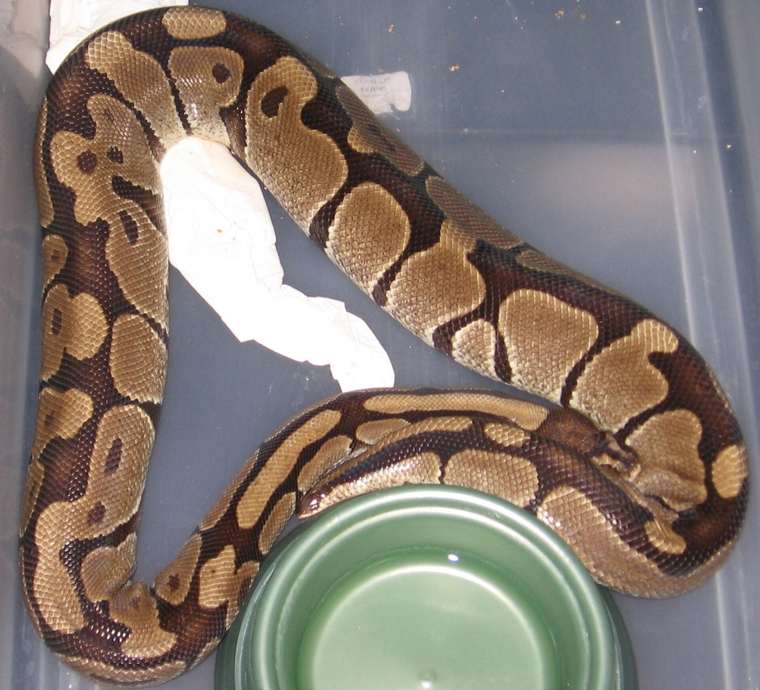
Selling hatchlings
Feeding first. There's no official standard for how many meals a hatchling should take before it's sold. Breeders commonly wait for 3 to 5 meals in a row [2][3].
Honest listings.
- Visual genes as they look; hets only when they're 100% or proven (see Genetics).
- Disclose any defect, and never sell an animal with a known problem as a breeder (see Genes to avoid).
- Photos of the actual animal.
Shipping
- Overnight only, Monday to Wednesday, in insulated, certified packaging. One large reptile marketplace requires overnight FedEx or UPS service and at least ½ in of foam [4].
- Temperature limits (the same marketplace's rules) [5]:
- Below 35 °F: don't ship.
- 35 to 70 °F: use a heat pack.
- 70 to 85 °F: no pack needed.
- 85 to 95 °F: have the box held at the carrier's facility for pickup.
- 95 °F or above: don't ship.
- USARK's shipping table differs slightly [6].
- Carriers: USPS doesn't accept snakes at all [7]. FedEx needs an approved live-animal account, a tested package, overnight service and a "live harmless reptile" label [8]. UPS ships non-venomous snakes only under contract, next-day service, never on a Friday [9].
See Buying and shipping in the Care Guide for the buyer's side.
The legal basics (US)
- The Animal Welfare Act doesn't cover reptiles. Under that law, "animal" means only dogs, cats, certain small mammals and other warm-blooded animals, so snakes aren't covered [10].
- Ball pythons aren't on the Lacey Act's injurious species list. That list covers several large constrictors (Burmese, reticulated and African rock pythons, and some anacondas). A 2017 court ruling also allows listed species to be moved between states within the continental US [11][12].
- Hawaii prohibits snakes entirely, so don't sell to Hawaii buyers [13].
- State rules vary. New York, for example, bans several large python species as pets but not the ball python [14]. Check your state and your buyer's.
- Sales tax generally applies to animal sales; check your state's rules [15].
Closing out the year
- Finish every card: introductions, locks, ovulation, pre-lay shed, lay date, egg count, slugs, hatch dates, hatch weights, defects, buyers.
- Note what worked and what didn't: incubator readings, feeding problems, any female who struggled.
- Plan next season around which females are truly ready, not which pairings look best on paper.
Step by step
Wrapping up the season:
- Once the female has settled after laying, offer a modest meal. Build back to her normal schedule and weigh her every two weeks.
- Count each hatchling's meals. We sell only after at least four meals in a row.
- Write down each baby's shed and feeding history for the buyer.
- Write an honest listing: visual genes as they look, hets only if 100% or proven, any defect, and photos of the actual animal.
- Check your state's rules and your buyer's. Never sell to Hawaii.
- Check the weather at both ends before you ship. Ship overnight, Monday to Wednesday, within the temperature limits above.
- Finish every record card, and note what worked and what didn't.
- In the fall, let each female's weight and condition decide whether she breeds next year.
Sources for this chapter
- Ellis, T. M. and Chappell, M. A. (1987), Journal of Comparative Physiology B 157: 393–402, PDF
- FurryCritter, Neonate care (hobby site)
- MorphMarket Community, When to sell a hatchling (keeper forum)
- MorphMarket Support, How to ship live reptiles
- MorphMarket Support, Shipping temperatures
- USARK, Shipping temperature table
- USPS Publication 52, §525 Live animals
- FedEx, How to ship live animals
- UPS, Plants and animals
- 9 CFR §1.1, definitions (Animal Welfare Act regulations)
- Federal Register, 80 FR (March 10, 2015), Injurious wildlife: four large constrictors
- US Fish and Wildlife Service, Implementation of USARK v. Zinke
- Hawaii Department of Agriculture, List of prohibited animals (PDF)
- New York Environmental Conservation Law §11-0103(6)(e), text
- New York State, Publication 851 (sales tax and animals) (PDF; written for veterinarians)