Chapter 10 of 13 · Ball Python Breeding Guide
Hatching and hatchlings
Disclaimer: I'm not a veterinarian and I don't hold a degree in animal science or animal care. This is a guide I compiled and use for my own ball pythons. For a sick or egg-bound snake, a reptile vet is the authority.
The short version
- Babies cut a slit in the shell (pipping), then often stay inside for 24 to 48 hours. Leave them in the egg.
- If a baby comes out with yolk still attached, don't cut the cord. Put it on damp paper towel, warm and dark.
- Give each baby its own small tub with a hide, a water dish, and a warm side and a cooler side.
- The first shed comes 7 to 14 days after hatching. Offer the first meal a few days after that.
- Weigh babies weekly. A baby that loses more than 15% of its hatch weight needs a vet.
Pipping
Near the end of incubation, each baby slits its shell with an egg tooth (pipping) and pokes its nose out. Most then rest in the egg, absorbing the last of the yolk, and crawl out 24 to 48 hours later [1][2]. Many emerge at night [2].
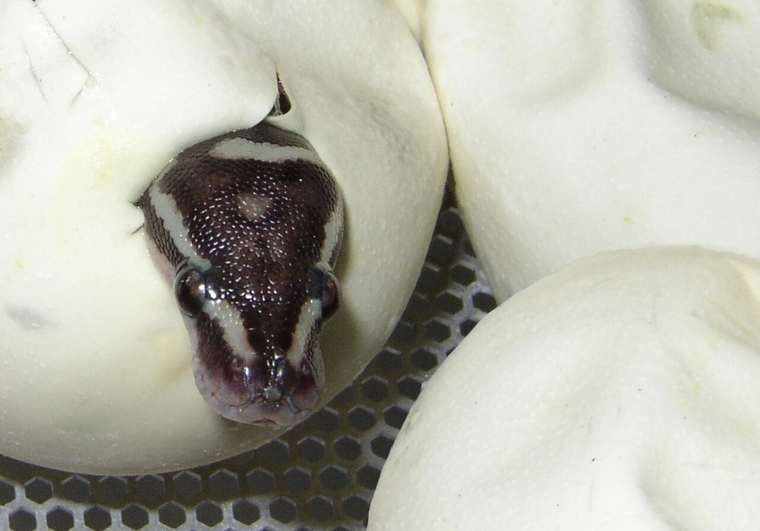
Leave them in the egg. A baby still in its egg is finishing its yolk. Pulling one out early can tear the yolk sac, which risks infection and loses its food reserve [3].
The egg-cutting debate
Some breeders cut the eggs open themselves, either once the first baby in a clutch has pipped or on a set day (often day 52 to 55). They do it so babies don't drown in egg fluid or get tangled in the umbilical cord [4]. Others don't: cutting too early, or nicking a blood vessel, kills babies too, and one keeper bets "more babies are lost every year due to cutting than drowning" [4]. There is no study either way.
The yolk and umbilical scar
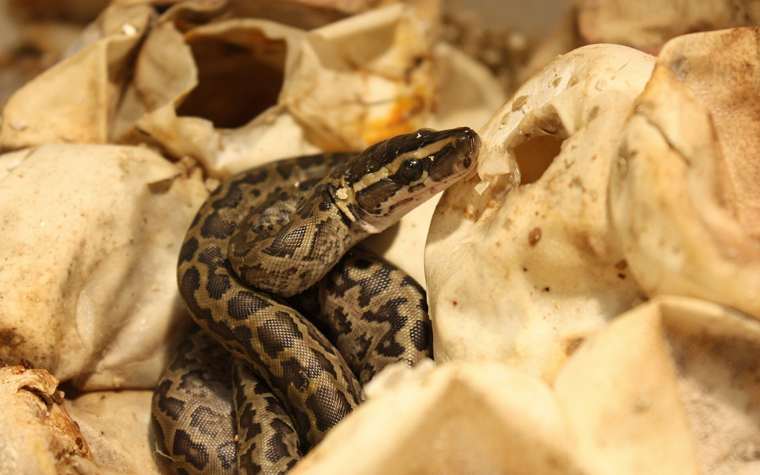
A baby that comes out with yolk still attached goes on damp paper towel, warm and dark, for 12–24 hours. Don't cut the cord or push the yolk in; the remnant dries and drops off within a few days. Redness, swelling or discharge at the scar is a vet visit [3]. The egg tooth falls off within a week or two [3].
Setting up hatchlings
Hatchlings weigh about 50–100 g; one study measured 50.2 ± 6.7 g, and a species account gives 65–103 g [1][5].
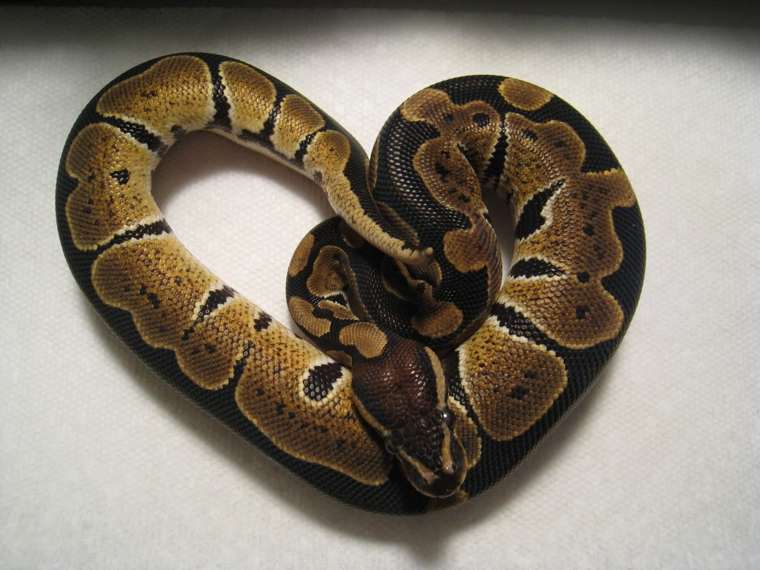
- Each baby in its own small, ventilated tub on paper towel, with a snug hide and a small water dish [6].
- The same temperatures as in Heat at hatchling scale: a warm side and a cooler side.
- Labelled with its clutch and egg number from day one.
First shed and first meal
- The first shed usually comes 7 to 14 days after hatching [6].
- Offer the first meal a few days after that shed [6]. Don't panic if a baby refuses at first: in one study, 14 of 15 hatchlings didn't eat for 20 to 40 days, then fed well [1].
- Prey size: about 10–12% of the hatchling's weight for young snakes, or no wider than the widest part of its body [7].
- Thawed prey warmed to about body temperature; never leave live prey with a snake unattended [8]. See Feeding for the full method.
Problem feeders. Weigh weekly. After a refusal, wait 3 to 5 days and try again. Try scenting and other tricks after 3 to 4 weeks of refusals. Assist-feeding is a last resort. Only try it after 6 to 8 weeks, and only if the baby is really losing weight. A hatchling that has lost more than 15% of its hatch weight needs a vet [6]. Babies can decline fast; a reptile expert quoted in a vet-reviewed article warns a non-feeding baby "can crash and burn" [9].
Step by step
From pip to first meal:
- When the eggs pip, leave them alone. Babies usually come out 24 to 48 hours later, often at night.
- Don't pull a baby out early.
- If a baby comes out with yolk attached, put it on damp paper towel, warm and dark, for 12–24 hours. Don't cut the cord or push the yolk in.
- Move each baby to its own ventilated tub with paper towel, a snug hide and a small water dish.
- Give it a warm side and a cooler side (see Heat).
- Label the tub with its clutch and egg number.
- Wait for the first shed, usually 7 to 14 days after hatching.
- A few days after that shed, offer a thawed meal warmed to about body temperature. Prey should be about 10–12% of the baby's weight, or no wider than the widest part of its body.
- If it refuses, wait 3 to 5 days and try again. Weigh it every week.
- If it loses more than 15% of its hatch weight, take it to a vet.
Sexing
- Probing: a lubricated, blunt probe slides into the tail pocket. Males probe deeper than females. Sources differ on the numbers: about 8–16 subcaudal scales in males and 1–2 in females in one reference, about 6–14 and fewer than 6 in another [10][11].
- Popping: gently rolling a thumb up the underside of a baby's tail to evert the male organs. It's only reliable in the first weeks of life [10].
- Both carry real risks: a probe can puncture a female, and popping can injure the spine or misread a male as female [12]. They should be done by an experienced breeder or a reptile vet, not learned on your own snakes [13].
- DNA sexing from a shed is available for ball pythons [14]. Pythons have XY sex chromosomes, while most other snakes have a different system called ZW. So DNA sex tests made for other snakes don't work on pythons [12][15].
A baby with a defect
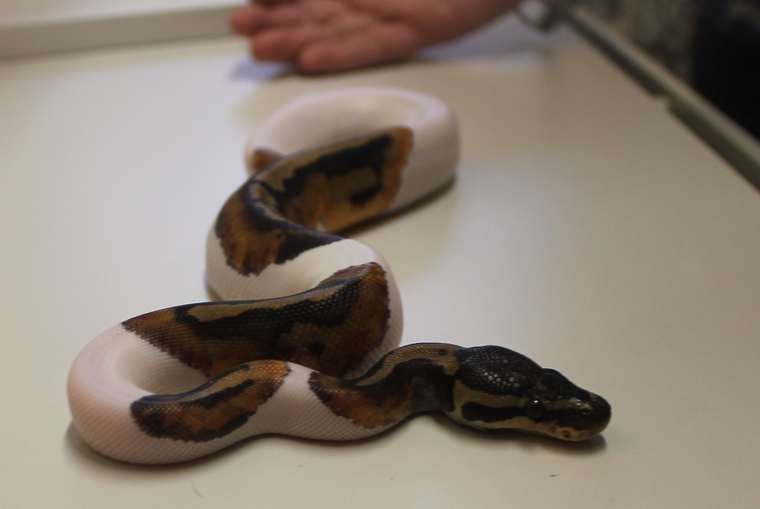
Kinks, wobble, eye defects and other problems turn up now and then. Judge movement, feeding and shedding only after the yolk is absorbed, then talk to a reptile vet [16].
Humane euthanasia is a vet's job. Reptiles are presumed to feel pain [17]. Cooling or freezing a hatchling is not an acceptable method, and decapitation alone isn't either, because a reptile's brain can keep working without oxygen [18]. A vet will use an overdose of anesthetic.
Record the parents and the incubation conditions of every abnormal baby. A pairing that keeps producing them should stop [16].
Sources for this chapter
- Ellis, T. M. and Chappell, M. A. (1987), Journal of Comparative Physiology B 157: 393–402, PDF
- ball-pythons.net, hatching thread (keeper forum)
- FurryCritter, Pipping (hobby site)
- ball-pythons.net, to cut or not to cut and cutting dates (keeper forum)
- Animal Diversity Web (University of Michigan), Python regius
- FurryCritter, Neonate care (hobby site)
- MoreReptiles (vet-reviewed), How often should ball pythons eat
- VCA Animal Hospitals, Snakes: feeding
- Chewy (vet-reviewed), Ball python not eating
- Barker, D. and Barker, T. (VPI), Determining the sex of snakes
- Merck Veterinary Manual, Probing snakes to identify sex
- Laboklin, Sex determination in snakes (veterinary lab, PDF)
- ReptiFiles, Ball python sexing
- Rare Genetics Inc. via MorphMarket, DNA testing
- Gamble, T. et al. (2017), Current Biology 27(14): 2148–2153, doi:10.1016/j.cub.2017.06.010
- FurryCritter, Deformed hatchlings (hobby site)
- AVMA Guidelines for the Euthanasia of Animals, 2020 edition, PDF
- San Francisco State University IACUC, Euthanasia guidelines