Chapter 8 of 13 · Ball Python Breeding Guide
Ovulation to laying
Disclaimer: I'm not a veterinarian and I don't hold a degree in animal science or animal care. This is a guide I compiled and use for my own ball pythons. For a sick or egg-bound snake, a reptile vet is the authority.
The short version
- Ovulation looks like a big swelling in the middle to lower part of her body, as if she ate a huge meal. It lasts about a day. After it, stop introductions.
- About 2 to 3 weeks later she sheds. This is the "pre-lay shed."
- Eggs usually come about 30 days after the pre-lay shed.
- Give her a warm side, fresh water, and a laying box with damp moss. Handle her only when you must. She will likely not eat.
- If laying starts and stops, she strains with no eggs, or she is well past her date, call a reptile vet. Never try to push eggs out yourself.
Ovulation
Ovulation shows as a swelling in the middle to lower third of the body, as if the female had swallowed a large meal, that lasts about a day [1][2]. It's easy to miss; even ultrasound couldn't reliably catch the exact moment in the 129-female study [2]. Once she ovulates, introductions stop.
The timeline
| Step | Typical timing | Source |
|---|---|---|
| Ovulation to pre-lay shed | about 2 to 3 weeks | breeders [1][3] |
| Pre-lay shed to laying | 28.8 ± 4.4 days | [2] |
| Ovulation to laying | 47.3 ± 6.1 days; a vet review gives 45 to 60 | [5][4] |
| Embryos visible by ultrasound | about 12 days before laying | [6] |
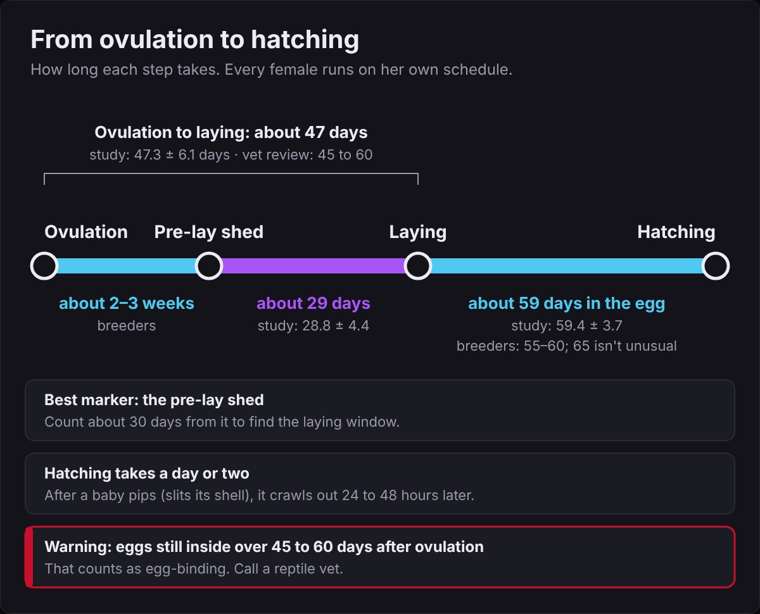
The pre-lay shed is the most reliable marker most keepers have: count about 30 days from it to find the laying window [1].
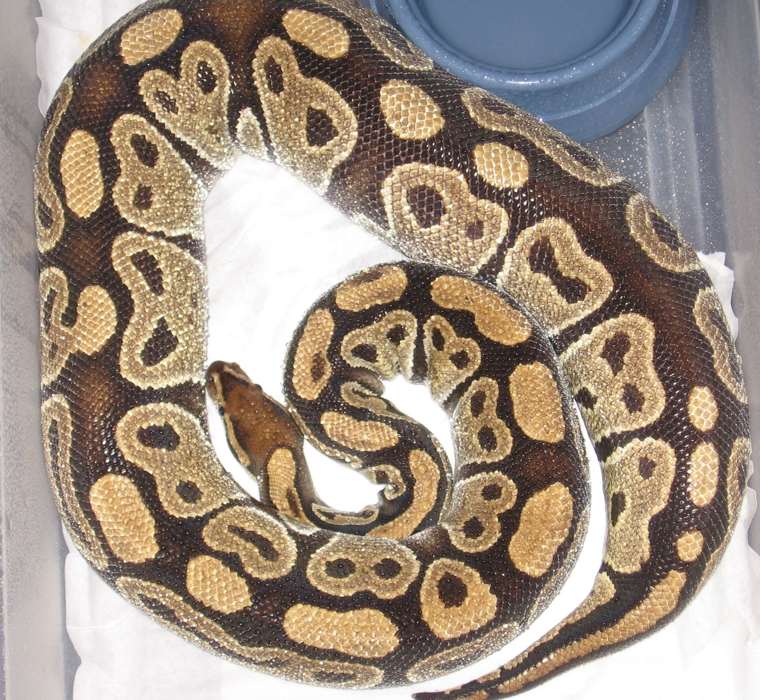
The gravid female
- Heat. Gravid pythons seek warmer temperatures. In Children's pythons, females carrying eggs chose about 31.5 °C (89 °F). When not breeding, they chose about 28.7 °C (84 °F). They stayed warmer in the last weeks before laying. With less heat, carrying the eggs took longer and the babies were weaker [7][8]. Give her a reliable warm side at the top of the normal range (see Heat).
- Food. Gravid females typically refuse food until after they lay [9]. Offering is fine; forcing isn't.
- Water. Always available; she may soak.
- Handling. Keep it to essential checks.
The laying box
Give her a private, slightly humid place to lay: a hide or tub with an entrance hole, lined with slightly damp sphagnum moss. No study tests laying-box designs; this is keeper practice. A female without a suitable site can hold her eggs, which is one of the causes of egg-binding [10].
Step by step
From ovulation to eggs:
- Watch for ovulation: a swelling in the middle to lower third of her body that lasts about a day. Write down the date.
- Stop introductions.
- Give her a reliable warm side at the top of the normal range (see Heat), and water at all times.
- Keep handling to essential checks. You can offer food, but never force it.
- Wait for the pre-lay shed, about 2 to 3 weeks after ovulation. Write down the date.
- After the shed, put in a laying box: a hide or tub with an entrance hole, lined with slightly damp sphagnum moss.
- Count about 30 days from the shed. From about day 24, check on her quietly every day (our plan).
- When she lays, make sure the whole clutch came out. Most females finish within a day. If not, read the next section.
Egg-binding (dystocia)
Most females lay their whole clutch within a day. Problems to watch for [4][10][11]:
- laying that starts and then stops, or eggs still inside after the rest are laid;
- straining without producing eggs, prolapse, lethargy, a swollen lower body;
- a female well past her expected date. Most lay about 41 to 53 days after ovulation, or about 24 to 33 days after the pre-lay shed [2][5]. If 60 days have passed since ovulation, or about 6 weeks since the pre-lay shed, and there are no eggs, see a reptile vet. An X-ray shows whether eggs are stuck [4].
What to do. Call a reptile vet as soon as laying stalls or she strains without passing eggs. Don't wait to see what happens. Egg-binding needs treatment within 48 to 72 hours of the first laying attempts, and the longer it waits, the harder it is to fix [4][10]. The vet may give calcium, or a hormone called oxytocin (it works in fewer than half of snakes). Draining the eggs with a needle is a last resort with real risks. Surgery is another option [4][10]. Don't try to massage eggs out at home; a ruptured oviduct is a far worse problem than a vet visit.
Sources for this chapter
- Northwest Reptiles (breeder), So you wanna be a ball python breeder
- Bertocchi, M. et al. (2018), PLOS ONE 13(6): e0199377, doi:10.1371/journal.pone.0199377
- ball-pythons.net breeder thread, ovulation, pre-lay shed and laying dates (keeper forum)
- Morel, M. et al. (2025), causes and management of egg-binding (dystocia) in reptiles, a review, Veterinary Sciences 13(1): 30, PMC12846459
- University of Pisa veterinary thesis (2024), 48 females (abstract), etd.adm.unipi.it
- Bertocchi et al. (2018), embryonic vesicles 12.1 ± 2.3 days before laying, repository PDF
- Lorioux, S. et al. (2012), maternal thermoregulation in Children's pythons, Journal of Experimental Biology 215: 1346, PDF
- Lourdais, O., DeNardo, D. F. and Heulin, B., gravid Children's pythons keep higher body temperatures (abstract), SICB
- Ellis, T. M. and Chappell, M. A. (1987), Journal of Comparative Physiology B 157: 393–402, PDF
- Vet Times (2009), Reproductive diseases in reptiles
- Merck Veterinary Manual, Reproductive diseases of reptiles