Chapter 3 of 13 · Ball Python Breeding Guide
Genetics
Disclaimer: I'm not a veterinarian and I don't hold a degree in animal science or animal care. This is a guide I compiled and use for my own ball pythons. For a sick or egg-bound snake, a reptile vet is the authority.
The short version
- Every baby gets one copy of each gene from mom and one from dad, picked at random.
- A recessive gene, like Clown or Piebald, only shows with two copies. A snake with one hidden copy looks normal and is called a "het."
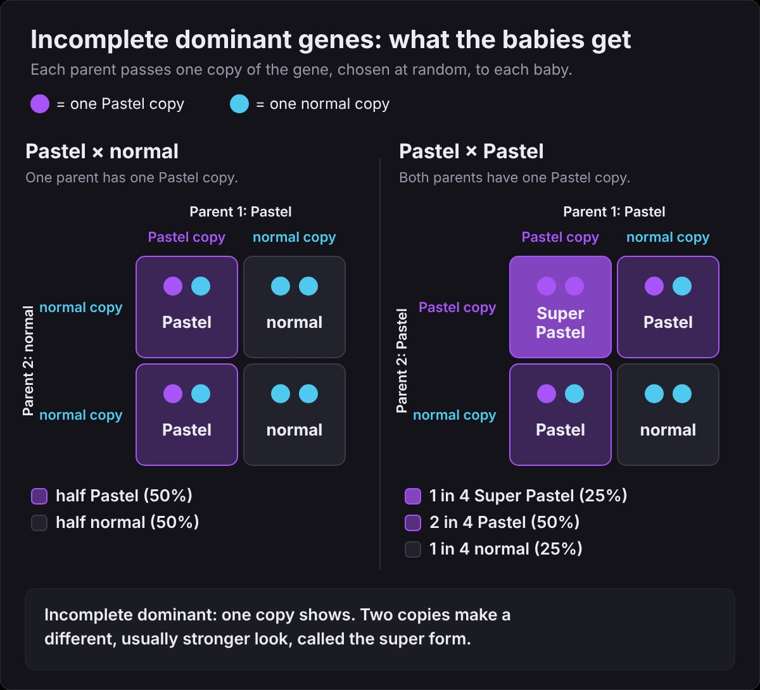
- With an incomplete dominant gene, like Pastel, one copy shows. Two copies make a stronger look called the "super" form.
- Het × het gives 1 visual baby in 4 on average. Each egg is a new roll, so a clutch can have none.
- A "66% het" or "50% het" is a chance, not a sure thing. Only a DNA test or the snake's own babies can prove it.
The basics
Every ball python carries two copies of each gene, one from each parent, and passes one copy, chosen at random, to each baby. A "morph" is a snake with a visible mutation. How a mutation shows depends on its type.
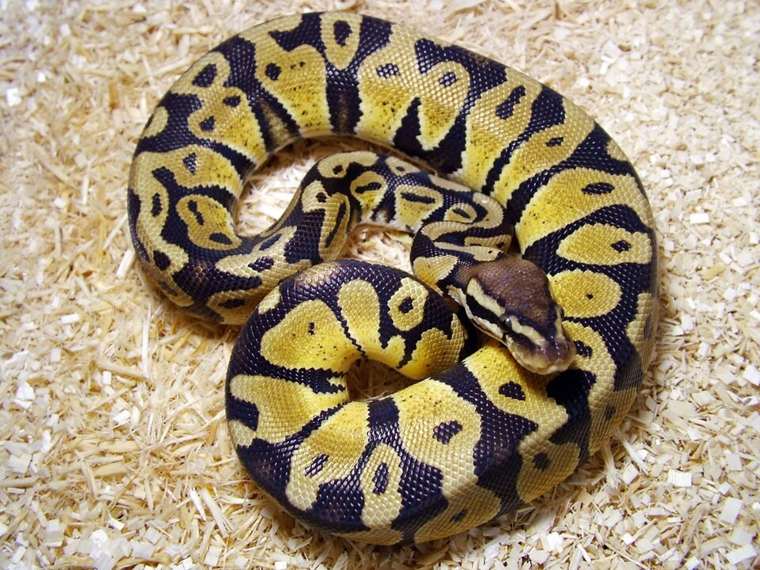
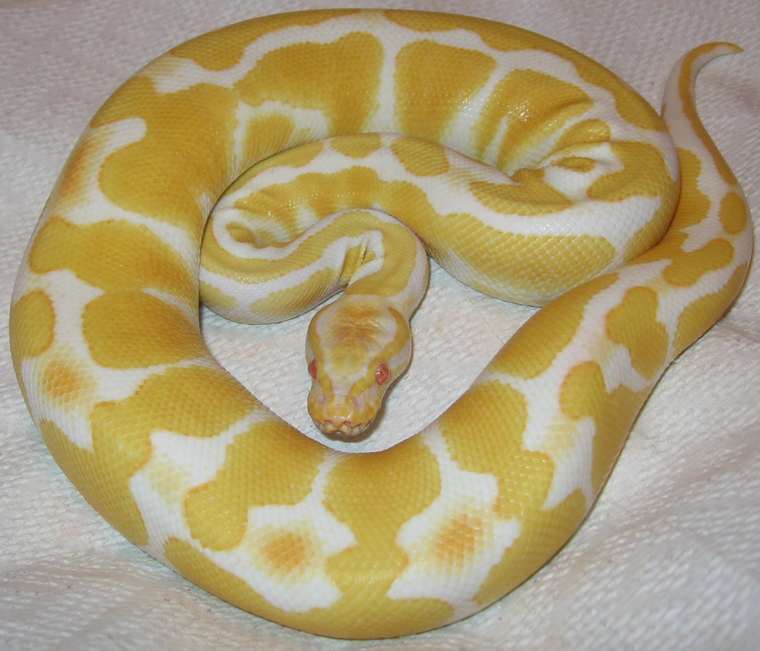
Recessive. It only shows when a snake has two copies. A snake with one hidden copy looks normal and is called a het (heterozygous). Clown, Piebald, Albino, Hypo and Axanthic are recessive [1][2][3]. Some of these have now been traced to specific genes: Piebald to TFEC [4], Albino to TYR [5], Clown to MC1R [6] and VPI Axanthic to gch2 [7].
Incomplete dominant. One copy shows, and two copies make a different, usually stronger, look called the super form: Pastel and Super Pastel, for example [1][8]. Pastel, Enchi, Lesser, Mojave, Banana (Coral Glow), Cinnamon and Yellow Belly are listed this way [1].
Dominant. One copy and two copies look the same. Pinstripe is the usual example [9].
Recessive crosses at a glance
| Parents | Babies |
|---|---|
| visual × visual | all visual |
| visual × het | half visual, half het |
| visual × normal | all het |
| het × het | 1 in 4 visual, 2 in 4 het, 1 in 4 normal |
| het × normal | none visual; half are het, but you can't tell which |
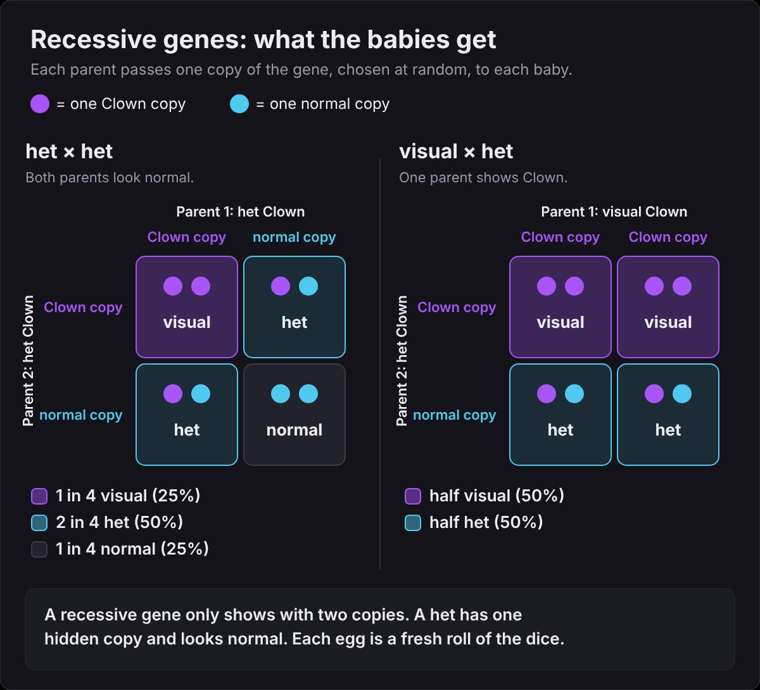
Possible hets. From het × het, the normal-looking babies are each 2 in 3 (66%) likely to be het. From het × normal, each baby is a 50% possible het [10]. These percentages are chances for one animal, not a gene it carries.
Each egg is a fresh roll. "1 in 4" is an average over many eggs. A clutch of six from het × het can easily give no visuals, or three.
Proving a het
- DNA test. Labs test shed skin for many recessive genes and report whether the snake carries none, one or two copies. Rare Genetics Inc. (RGI) offers single-gene tests and panels [11]. Not every gene has a test yet, so check the lab's list before you order [11].
- Test breeding. Breed the possible het to a visual. If the parent really is het, each baby has a 1 in 2 chance of being visual [10]. Any single visual baby proves it. Normal-looking babies make "het" less likely but never rule it out for sure. After 10 normal babies in a row, the chance the parent is het is about 1 in 1,000 for a 50% possible het, and about 1 in 500 for a 66% one [12].
Genes that share a slot (allelic complexes)
Some mutations sit at the same place in the genome. A snake can carry only two of them in total, and two different ones together can make something new.
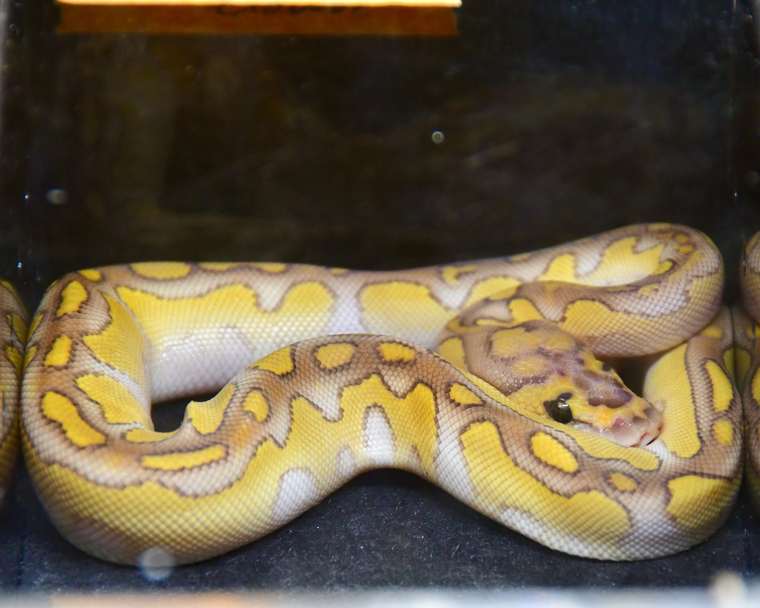
- The BEL group (blue-eyed leucistic): Lesser, Butter, Mojave, Russo, Phantom, Mystic, Special and others. Two of these together make a white or near-white snake with blue eyes [13]. Butter and Lesser are treated as the same mutation; RGI tests them together [11][1].
- Clown and Cryptic are different changes in the same gene (MC1R). One copy of each makes the "Crypton" [6].
- Albino and Candy share a gene (TYR) [5]. Albino, Ultramel and a third albino type (an OCA2 deletion) sit on different genes, so crossing any two of those gives normal-looking babies [5].
- The Spider group (Spider, Champagne, Woma, Hidden Gene Woma, Black Head, Spotnose and others) is covered in Genes to avoid [13].
Lines that don't mix
Two snakes can look the same and still carry different mutations. Axanthic is the clearest case. The VPI line is a change in one gene, gch2 [7]. Other Axanthic lines are not in that same slot. If you cross two different lines, the babies look normal, and each one carries one copy of each line [14]. RGI sells a separate test for the VPI line and for each of two other Axanthic lines [11]. Pick one line and stay with it.
When the simple rules break
- Desert Ghost looks recessive, but lab work found at least two separate genes involved; a visual needs a copy at each [15]. The lab says treating it as a simple recessive still works well for planning, but at least one more gene seems to play a part, so results may not match a calculator [15]. RGI now tests for both main genes [11].
- Banana / Coral Glow is linked to the sex chromosomes. Pythons have XY chromosomes like mammals [16]. A male can carry the gene in one of two places. If it's on his Y (which came from his father), he mostly makes Coral Glow sons. If it's on his X (which came from his mother), he mostly makes Coral Glow daughters. A female passes it to about half her babies of either sex. Occasional crossover between X and Y explains the odd "wrong" sex [17].
Using a genetics calculator
Online genetics calculators list the possible babies from two parents [18]. They're a good check, with limits:
- They assume one gene, simple inheritance. They don't handle Desert Ghost's extra genes, Banana's sex linkage, or complexes nobody has proven.
- Some can't take "66% possible het" as an input; run the cross twice, once as het and once as not [19].
- They say nothing about health. A cross can be genetically possible and still a bad idea.
Step by step
Planning a pairing:
- Write down every gene each parent has. Mark each het as proven or "possible."
- Check the lines. If either parent has Axanthic, make sure both are the same line.
- Check for genes that share a slot, like the BEL group, and read Genes to avoid.
- Use the table above, or a genetics calculator, to see the odds.
- If a parent is a 66% possible het, run the calculator twice: once as het and once as not.
- Remember the odds are averages. Each egg is a fresh roll.
Sources for this chapter
- MorphMarket Morphpedia gene pages: Clown, Hypo, Pastel, Enchi, Lesser, Mojave, Banana, Yellow Belly (hobby reference, not peer-reviewed)
- MorphMarket Support, Understanding genetics
- Morphpedia, Cryptic and Caramel Albino
- Piebaldism and chromatophore development in reptiles are linked to the tfec gene, Current Biology, NSF repository
- Brown, A. R. et al. (2022), albinism genes in ball pythons, PLOS ONE 17(10): e0276376, doi:10.1371/journal.pone.0276376
- García-Elfring, A. et al. (2025), Clown and Cryptic in MC1R, Pigment Cell & Melanoma Research 38(1): e13215, PDF
- García-Elfring, A. et al. (2025), VPI Axanthic and gch2, Animal Genetics 56: e70011, OMIA entry
- Northwestern University genetics glossary, Incomplete dominance
- MorphMarket Morphpedia, Pinstripe
- FurryCritter, Punnett squares (hobby site; the ratios are standard Mendelian genetics)
- Rare Genetics Inc. via MorphMarket, DNA testing
- Wikipedia, Bayes' theorem (general reference for the math: each normal baby from a het × visual cross halves the odds that the parent is het)
- MorphMarket Community, Allelic morphs (complexes) (community-maintained list)
- García-Elfring, A. et al. (2025), VPI Axanthic and gch2, including crosses between Axanthic lines, Animal Genetics 56: e70011, doi:10.1111/age.70011; open preprint at bioRxiv
- MorphMarket blog (RGI), Desert Ghost decoded
- Gamble, T. et al. (2017), XY sex chromosomes in a boa and a python, Current Biology 27(14): 2148–2153, doi:10.1016/j.cub.2017.06.010
- Mallery, C. S. and Carrillo, M. M. (2016), sex-linked Coral Glow in ball pythons, University of São Paulo herpetology journal, 15(1): 29–42, doi:10.11606/issn.2316-9079.v15i1p29-42
- MorphMarket Support, Genetic calculators
- MorphMarket Community, Possible-het input to the calculator (keeper forum, archived copy)