Chapter 9 of 13 · Ball Python Breeding Guide
Eggs and incubation
Disclaimer: I'm not a veterinarian and I don't hold a degree in animal science or animal care. This is a guide I compiled and use for my own ball pythons. For a sick or egg-bound snake, a reptile vet is the authority.
The short version
- A clutch is usually about 6 to 7 eggs. Small, yellowish eggs are slugs, which won't hatch.
- Don't turn or roll the eggs. Mark the top of each one with a soft pencil before you move them.
- Keep the temperature steady and check it on a second thermometer next to the eggs. We plan to run 88–89 °F. Running too hot causes more defects than running a little cool.
- Keep the air very humid, but keep the eggs from getting wet.
- Eggs take about 2 months to hatch.
The clutch
- Size: a facility that logged 5,344 eggs from 783 clutches averaged 7 eggs per clutch and hatched 81% of them [1]. The 129-female study counted 6.3 ± 2.3 fertile eggs plus 1 or 2 slugs per clutch on average [2].
- Eggs: about 85 g each; the whole clutch about 32% of the female's weight before laying [3].
- Slugs (infertile eggs) are smaller and yellowish [2].
- Stuck together: fertile eggs often stick in a cluster. Most breeders leave the cluster whole and move it as one piece; pulling eggs apart can tear the shells.
Don't turn the eggs
Soon after laying, a snake embryo attaches to the inside of the shell, usually near the top. In a study of water snakes, turned eggs and unturned eggs hatched at about the same rate. But afterward, 37.5% of the babies from turned eggs died, against only 4.5% from unturned eggs. The authors recommend incubating eggs in the position they were laid [5].
Mother or incubator?
Maternal incubation. A female coils around her clutch for about two months. When she coils around the eggs, it barely changes their temperature, but it does a lot to stop them drying out. Eggs she sat on gave bigger, more active babies [6]. In one study, all the eggs were at about 29 °C (84 °F). Eggs left with the female hatched at 58–59 days. Eggs taken away hatched at 71–76 days. Both groups lost the same share of eggs [3]. A female can't cover an oversized clutch, and the eggs she can't reach dry out [7]. If you go this way, keep the enclosure in the low to mid 80s °F with humidity around 80% [8], and expect her not to eat until the eggs hatch [3].
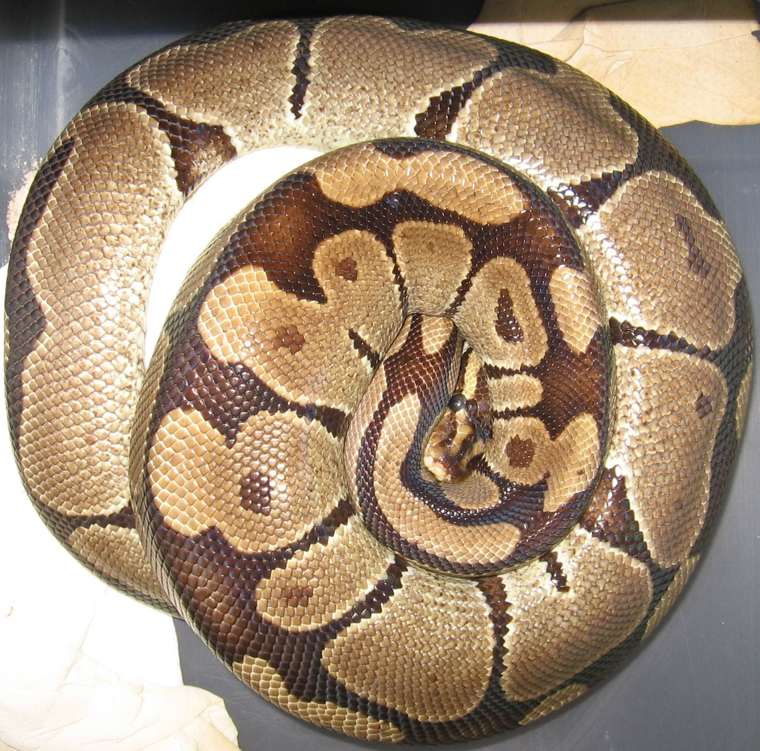
Artificial incubation lets the female start eating and recovering sooner, and is what most breeders do.
Choosing an incubator
What matters is a temperature that stays put. One breeder guide says to keep it within 0.5 to 1 °F of the set point [15].
- Cooled lab incubators (compressor-cooled) hold a set point within about ±0.2–0.5 °C and can cool as well as heat [9]. They handle a hot summer room, which is when eggs are incubating.
- Heat-only reptile incubators work well in a stable room, but can't cool; a summer heat spike pushes them over. Their built-in sensors may not read egg-level temperature, so manufacturers say to add a second thermometer at egg height [10].
- Styrofoam still-air incubators depend heavily on room temperature; a room that swings 10 °F or more changes the inside temperature [11]. In one keeper's side-by-side test of three incubators, one ran about 2 °F cooler at the egg box than its display showed [12].
- Converted wine coolers with a good thermostat are a common keeper build [13].
Whatever you use: a quality proportional thermostat, a second independent thermometer next to the eggs [10], and a test run with the empty incubator before eggs go in. One maker says at least half a day [11]; a longer run shows how it copes with the room warming and cooling.
Temperature
- The 783-clutch facility incubated at 30.9 to 31.7 °C (87.6 to 89.1 °F) [1].
- Breeders run 86–92 °F, most at about 88–90 °F; eggs at 88–89 °F hatch 3 to 5 days later than at 91–92 °F [14][15]. Hobby sources say running too hot causes more defects than running slightly cool, so they lean toward the cooler end [23].
- Cooler incubation takes longer: 63 days at 30.5 °C (87 °F) for one clutch in an older study, and 71 to 76 days at 29–30 °C (84–86 °F) in another [16][3].
- No study ties incubation temperature to kinks in ball pythons specifically. In pine snakes, abnormalities appeared only in cold incubation, and hatching success fell at 32 °C [17].
Humidity and substrate
The egg box needs very humid air without wet eggs.
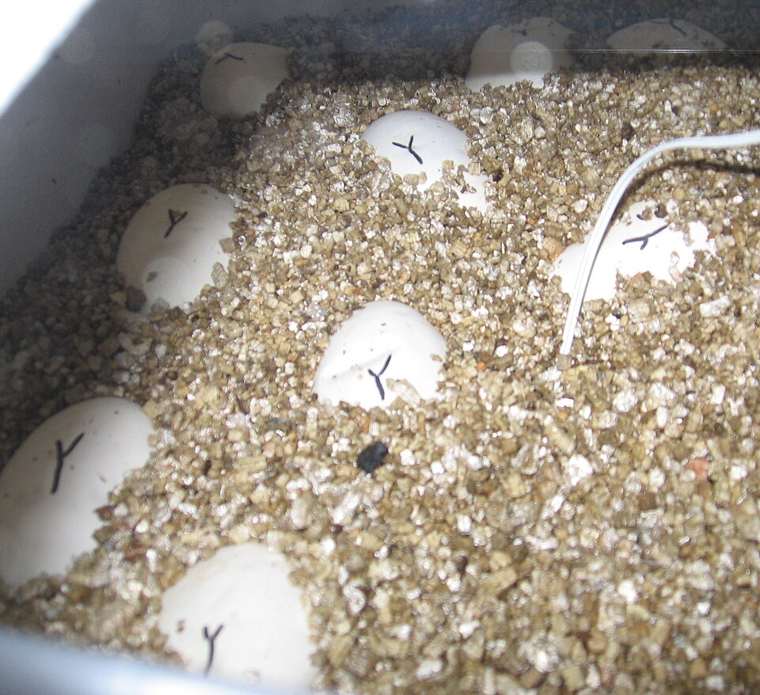
- Vermiculite or perlite with water. A common mix is equal weights of vermiculite and water, about 3 in deep [8][15]. The 783-clutch facility used perlite and vermiculite 1:2 by volume, moistened with water [1].
- Pre-mixed substrates need no mixing; one maker says to just pour it in [18].
- Suspended incubation (eggs on a grid over water, not touching any substrate) is used by some keepers [19]. With no substrate to buffer it, humidity needs closer watching [25]. Make sure the grid is secure so a hatchling can't end up in the water.
- Don't let condensation drip on the eggs: tilt the lid as you open it, and set the box so drops run to the edges [4].
- Humidity targets differ: about 90% in one breeder guide, 80–100% in another [14][15].
Checking the eggs
- Candling. In a dark room, shine a cool light against the shell. A fertile egg shows blood vessels, visible from about a week after laying in some reports and around day 14 in others; an egg that is still clear at 2–3 weeks is unlikely to hatch [20][21]. Don't lift or roll the egg to do it, and use a light that doesn't get hot.
- Dents. Collapse in the first few weeks means the eggs are drying out: add a little water to the substrate, not to the eggs [8][4]. Dents in the last week or so are normal, as the baby uses up what is in the egg [24].
- Swollen, bloated eggs mean too wet [20][4].
- Mold. Sources disagree. One article says patches on the shell are mostly harmless and best left alone; a substrate maker says moldy eggs are best removed, unless they are stuck in a cluster [20][18]. A clearly dead, moldy slug can come out; a fertile egg stuck to a moldy one stays.
How long
59.4 ± 3.7 days from laying to hatching in one study [22]; breeders commonly see 55–60, and 65 isn't unusual [15].
Step by step
Incubating a clutch:
- Before the season, do a test run with the empty incubator (we run it two weeks), with a second thermometer at egg height.
- Set up the egg box with damp vermiculite or perlite. A common mix is equal weights of vermiculite and water, about 3 in deep.
- Don't let condensation drip on the eggs: tilt the lid as you open it, and set the box so drops run to the edges.
- When she lays, mark the top of each egg with a soft pencil before anything moves.
- Move a stuck-together cluster as one piece. Don't pull eggs apart, and don't turn them.
- Set the eggs in the egg box in the position they were laid, pencil mark up.
- Check the temperature every day on the second thermometer.
- Candle the eggs with a cool light, without lifting or rolling them.
- Watch for dents in the first few weeks (add a little water to the substrate, not the eggs) and for swollen, bloated eggs (too wet).
- Expect hatching about 2 months after laying.
Sources for this chapter
- Morrill, B. H. et al. (2011), Herpetological Review 42: 226–231, summary at Conservation Evidence
- Bertocchi, M. et al. (2018), PLOS ONE 13(6): e0199377, doi:10.1371/journal.pone.0199377
- Ellis, T. M. and Chappell, M. A. (1987), Journal of Comparative Physiology B 157: 393–402, PDF
- FurryCritter, Incubation moisture levels (hobby site)
- Aubret, F., Blanvillain, G. and Kok, P. J. R. (2015), egg turning in snakes, Scientific Reports 5: 13385, PMC4543940
- Aubret, F. et al. (2005), maternal brooding in ball pythons, Evolutionary Ecology Research 7: 743–758, abstract (archived)
- Aubret, F. et al. (2003), clutch size and brooding in ball pythons, Biological Journal of the Linnean Society 78: 263, summary
- Reptiles magazine (2006), Python egg incubation
- PHCbi (Panasonic), MIR-154 cooled incubator specifications (manufacturer)
- Zoo Med ReptiBator, product specifications via Josh's Frogs (retailer copy of manufacturer text)
- GQF Hova-Bator, instructions (manufacturer, PDF)
- GeckoTime (2015), A tale of three incubators (keeper blog)
- MorphMarket Community, Good incubator recommendations (keeper forum)
- Northwest Reptiles (breeder), So you wanna be a ball python breeder
- MoreReptiles (vet-reviewed), Ball python egg incubation
- van Mierop, L. H. S. and Bessette, S. M. (1981), summary at Conservation Evidence
- Burger, J. et al. (1987), incubation temperature in pine snakes, PDF
- HatchRite instructions via LLLReptile (retailer copy of manufacturer text)
- MorphMarket Community, Incubation methods (keeper forum)
- Reptiles magazine, Candling and egg problems
- Incubator Warehouse, Reptile egg candling (retailer)
- University of Pisa veterinary thesis (2024), 48 females (abstract), etd.adm.unipi.it
- FurryCritter, Deformed hatchlings (hobby site)
- MorphMarket Community, Incubation eggs denting (keeper forum)
- FurryCritter, Incubation medium (hobby site)