Chapter 4 of 13 · Ball Python Breeding Guide
Genes to avoid
Disclaimer: I'm not a veterinarian and I don't hold a degree in animal science or animal care. This is a guide I compiled and use for my own ball pythons. For a sick or egg-bound snake, a reptile vet is the authority.
The short version
- Most morph genes only change color and pattern. A few cause health problems, and breeding them makes more snakes with those problems.
- The Spider group causes a "wobble": the head tilts, corkscrews or misses when striking. We keep every Spider-group gene out, including Spotnose.
- Two copies of some genes cause defects. Super Cinnamon and Super Black Pastel can have a deformed face. Super Lesser (two copies of Lesser) is prone to bulging eyes.
- Caramel Albino and Desert are linked to fertility problems in females.
- Tell buyers about any defect. Never sell a wobbling, kinked or deformed baby as a breeder.
Why this chapter exists
Most morph genes change only color and pattern. A few come with health problems, and breeding them makes more animals with those problems. A 2026 study of UK ads found Spider ball pythons, the best-known morph with a welfare problem, still being advertised in 2024 [1]. Peer-reviewed research exists mainly for one of these (Spider); for the rest the best sources are breeder-maintained gene pages, and we say so.
The Spider group and the wobble
What it is. Spider ball pythons show a "wobble": the head tilts, corkscrews or misses when striking, worse when the snake is stressed or excited [2][3].
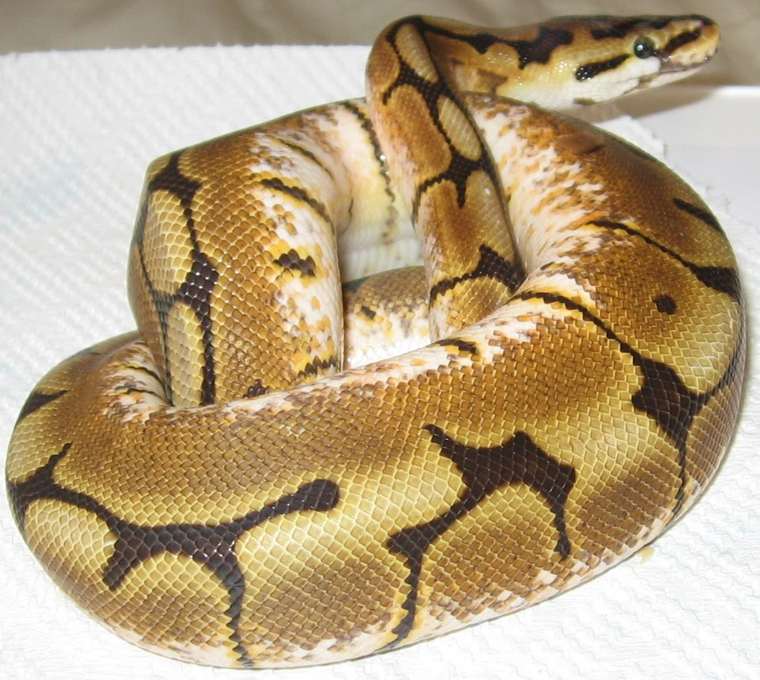
What the research found.
- An expert survey described the wobble as a heritable welfare problem [2].
- Micro-CT scans (very detailed X-ray scans) of 4 Spiders and 5 normal ball pythons found badly formed balance organs in the inner ear of every Spider and in none of the normal snakes. The sample was small, and the Spiders had been brought to a vet clinic because they wobbled [3].
- The same research team scanned these clinic Spiders with CT and MRI. They found inner-ear differences that they judged "highly likely" to be linked to the wobble. The brain and spine looked normal [4].
The rest of the group. Champagne, Woma, Hidden Gene Woma, Black Head, Chocolate, Spotnose and others are listed in the same allelic group [5]. Morphpedia lists wobble for Champagne and Hidden Gene Woma, and lethal or wobbling super forms [6][7]. Membership of some genes is still debated [7]. Keepers report a wobble in Super Spotnose and in Spotnose combined with Spider or Champagne; whether one copy of Spotnose causes a wobble is still argued about [14].
Super Cinnamon and Super Black Pastel
The single-copy forms are fine. Super Cinnamons "commonly express a deformed face" (often called duckbill) and are slightly more prone to kinked spines [8]. Super Black Pastels are reported with the same duckbill face and rare kinks [11]. Breeding two carriers together puts those odds on every egg.
Two genes from the BEL group together
Two genes from the BEL group (Lesser, Butter, Mojave, Russo, Phantom, Mystic, Special and others) make a white or near-white snake with blue eyes. Super Lesser is prone to bulging "bug eyes," sometimes in only one eye [9][10]. Butter is the same gene as Lesser, so Super Butter can have them too [9]. Snakes that are both a BEL combination and a visual Piebald, or a Super Lesser and an Albino, have been reported with small eyes [11].
Other genes with reported problems
- Caramel Albino: kinking and reduced fertility in females [11].
- Desert (a different gene from Desert Ghost): known fertility problems in females [12].
- Two-copy GHI: wrinkled hatchlings reported [11].
Step by step
Checking a pairing before you put two snakes together:
- List every gene each parent has, including hets and possible hets.
- If either parent has a Spider-group gene, including Spotnose, don't pair them.
- If both parents carry Cinnamon, or both carry Black Pastel, don't pair them. Every egg would have a chance of the two-copy form.
- If the pairing could put two BEL-group genes in one baby, don't pair them.
- Skip Caramel Albino and Desert, and avoid making two-copy GHI.
- After hatching, write down the parents and incubation conditions of any abnormal baby. Stop a pairing that keeps producing them.
Responsible breeding in practice
- Don't breed a gene, or a combination, with a known problem, however much it sells for.
- Disclose any defect, and never sell a wobbling, kinked or deformed hatchling as a breeder.
- Record the parents and incubation conditions of every abnormal baby, and stop a pairing that keeps producing them [13].
- A baby with a serious defect is a vet decision; humane euthanasia is covered in Hatching and hatchlings.
Sources for this chapter
- Bielby, J. et al. (2026), Royal Society Open Science 13: 251216, doi:10.1098/rsos.251216
- Rose, M. P. and Williams, D. L. (2014), neurological dysfunction in a ball python colour morph, Journal of Exotic Pet Medicine 23(3): 234–239, doi:10.1053/j.jepm.2014.06.002
- Starck, J. M. et al. (2022), inner-ear malformations in spider morph pythons, PLOS ONE 17(8): e0262788, doi:10.1371/journal.pone.0262788
- Schrenk, F. et al. (2022), CT and MRI of the inner ear in spider ball pythons, Journal of Comparative Pathology 196: 26–40, LMU repository
- MorphMarket Community, Allelic morphs (complexes) (community-maintained list)
- Morphpedia, Champagne (hobby reference)
- Morphpedia, Hidden Gene Woma (hobby reference)
- Morphpedia, Cinnamon (hobby reference)
- Morphpedia, Lesser (hobby reference)
- MorphMarket Community, Blue-eyed leucistic complex (keeper forum)
- MorphMarket Community, Morph issues in ball pythons (community-maintained list)
- Morphpedia, Desert (hobby reference)
- FurryCritter, Deformed hatchlings (hobby site)
- MorphMarket Community, Spotnose wobble (keeper forum)