Chapter 7 of 13 · Ball Python Breeding Guide
Introductions and locks
Disclaimer: I'm not a veterinarian and I don't hold a degree in animal science or animal care. This is a guide I compiled and use for my own ball pythons. For a sick or egg-bound snake, a reptile vet is the authority.
The short version
- Put the male into the female's enclosure and watch the first few minutes. Write it on both snakes' cards.
- A "lock" is when their tails are joined. It can last up to about a day. Never pull them apart.
- Use one male per female per season, so you know who the father is.
- One male can work several females, one at a time, with rest days in between.
- Only move a male between snakes that have finished quarantine and tested clean.
When to introduce
There's no single right moment, and the sources do it differently:
- One introduction at first follicle growth: in the 129-female study, the male went in for 24 hours once one follicle reached 10 mm [1].
- Repeated introductions as follicles grow: a breeder introduces at 8–12 mm, again at 17–22 mm and again at 27–32 mm [2].
- A fixed rhythm: another breeder runs 3 days together and about 2 weeks apart, repeated until the female ovulates [3].
Without an ultrasound, breeders start introductions when the season begins and keep them going until ovulation or the pre-lay shed.
The introduction
- The male goes into the female's enclosure. Watch the first few minutes; most pairs are calm.
- A courting male crawls along the female and uses his spurs (the two small claws beside the vent) to stimulate her.
- A lock is when their tails are joined. It can last many hours, up to about a day [4]. Don't separate a locked pair.
- Write every introduction and every lock on both snakes' cards.
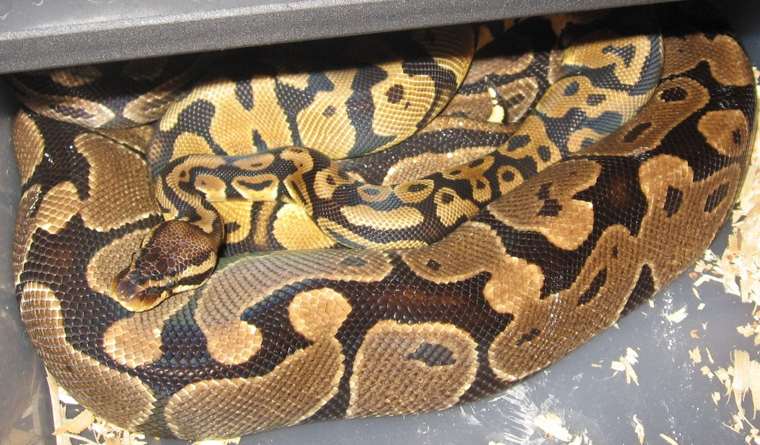
Step by step
Running introductions:
- Make sure both snakes have finished quarantine and tested clean.
- Pick one male for this female for the whole season.
- Choose your timing. With an ultrasound, go by follicle size. Without one, start when the season begins.
- Put the male into the female's enclosure. Watch the first few minutes.
- If they lock, leave them alone until they come apart.
- Write the introduction, and any lock, on both snakes' cards.
- Give the male rest days, and feed him only on a rest day (see Conditioning).
- Keep going until she ovulates or has her pre-lay shed.
- Watch the male's weight and appetite.
One male, several females
A male works one female at a time. Breeders with one male move him from female to female, with rest days in between. Without an ultrasound, one male usually works with 4 to 6 females a season [4]. Keep an eye on his weight and appetite (see Conditioning).
Biosecurity. When a male goes from one enclosure to another, he carries any disease or pests from the last one with him. Rotate only between snakes that have finished quarantine and tested clean.
Can a female store sperm? Can a clutch have two fathers?
- Female snakes can store sperm in the oviduct. A rattlesnake produced young about 6 years after any possible mating, confirmed by DNA [5]. That study wasn't on pythons, and no one has published a number for ball pythons. Don't count on stored sperm, but know that it can happen.
- Wild Burmese python clutches can have more than one father: three of four clutches studied had two sires [6].
What that means for breeders: if two males cover the same female in one season, you can't be sure who fathered which egg. For accurate records, use one male per female per season.
Sources for this chapter
- Bertocchi, M. et al. (2018), PLOS ONE 13(6): e0199377, doi:10.1371/journal.pone.0199377
- Breeder's Circle (R. Martins, breeder), Gearing up for breeding season
- Northwest Reptiles (breeder), So you wanna be a ball python breeder
- Ultimate Exotics (breeder; article by AME Exotics), Introducing ball pythons for breeding
- Levine, B. A. et al. (2021), six years of sperm storage in a rattlesnake, PLOS ONE, PMC8177532
- Skelton, J. et al. (2021), multiple paternity in Burmese pythons, Journal of Herpetology, USGS summary