Chapter 1 of 13 · Ball Python Breeding Guide
Start here
Disclaimer: I'm not a veterinarian and I don't hold a degree in animal science or animal care. This is a guide I compiled and use for my own ball pythons. For a sick or egg-bound snake, a reptile vet is the authority.
The short version
- Breeding takes about a year of planning. It is much more than putting two snakes together.
- Find a home for every baby before you pair. A clutch is usually about 6 to 7 eggs.
- A female stops eating while she carries eggs. She can come out a quarter to a third lighter.
- You need a good incubator, a backup thermometer, tubs, scales, and if you can, a vet with an ultrasound.
- Don't breed to get rich. The market is crowded, and many breeders find it hard to do more than break even.
Why this guide exists
Breeding ball pythons looks simple from the outside: put a male in with a female, wait, collect eggs. In real life it takes a year of planning. You need a heavy, healthy female, the right equipment, and a home for every baby, all before the eggs are laid. This guide shows how we do it. We checked it against published studies, vet books and experienced breeders. Every source is listed at the end of each chapter.
It sits next to Manny's Care Guide. Everything about keeping a ball python healthy (heat, humidity, feeding, quarantine) is there; this guide picks up where breeding changes the rules.
Is breeding for you?
The market is crowded. ReptiFiles names ball pythons as a saturated market and warns that it is "difficult to do more than break even" on reptile breeding [1]. A 2026 study of UK classified ads found that morph ads often listed several snakes at once, and noted that not every baby in a clutch turns out to be the morph the breeder wanted, which leaves extra snakes that need homes [2]. Breed because you want to make good animals and can place every one of them, not because the prices look good online.
It costs a female a lot. A female carries her eggs for weeks without eating and comes out of laying about a quarter to a third lighter [3]. Some skip the next year to recover.
Every baby is your responsibility. A clutch is typically about 6 to 7 eggs [4][5]. Each hatchling needs its own tub, weekly meals for at least a couple of months, and a buyer you'd be comfortable selling to.
It takes equipment and space: a reliable incubator and a backup thermometer, tubs for the hatchlings, scales, and ideally access to an ultrasound or a vet who has one.
Step by step
Before you put a male in with a female:
- Make sure your female is heavy and healthy (see Choosing breeders).
- Plan for about 6 to 7 babies, and line up a buyer you'd be comfortable selling to for each one.
- Get a reliable incubator and a backup thermometer.
- Get a tub for every hatchling, and enough rats for weekly meals for at least a couple of months.
- Get scales, and find a vet with an ultrasound if you can.
- Only then start introductions.
How to read this guide
Every number in it is one of three things, the same as the Care Guide:
- A veterinary reference or a published study. Cited with a link.
- A breeder or keeper source. Marked as such. Breeders have the most hands-on experience, but they rarely publish data. When breeders disagree with each other, the chapter tells you.
- Our practice is what we do in our room now. Our plan is how we have set up the parts of breeding we haven't reported results for yet. Other experienced breeders may do it differently.
Breeding is less studied than general care. Some common advice has no published source at all, and where that's the case we say it.
The breeding year on one page
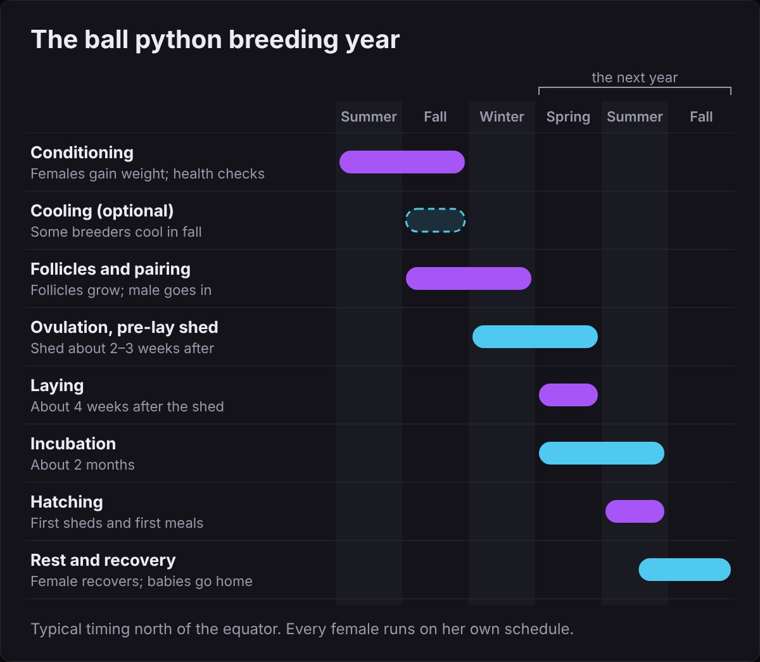
These are typical timings north of the equator; every female runs on her own schedule.
| When | What happens | Chapter |
|---|---|---|
| Summer–fall | Females put on weight; males and females are checked for health and readiness | Choosing and preparing breeders, Conditioning |
| Fall–winter | Follicles start growing; introductions begin | Follicles, Introductions and locks |
| Winter–spring | Ovulation, then a pre-lay shed about 2 to 3 weeks later | Ovulation to laying |
| Spring | Laying, about 4 weeks after the pre-lay shed | Ovulation to laying |
| Spring–summer | About 2 months of incubation | Eggs and incubation |
| Summer | Hatching, first sheds, first meals | Hatching and hatchlings |
| Late summer–fall | The female recovers; hatchlings go to new homes | After the season |
Sources for this chapter
- ReptiFiles, Responsible reptile breeding
- Bielby, J. et al. (2026), ball python adverts in the UK, Royal Society Open Science 13: 251216, doi:10.1098/rsos.251216
- Ellis, T. M. and Chappell, M. A. (1987), metabolism and incubation in ball pythons, Journal of Comparative Physiology B 157: 393–402, PDF
- Bertocchi, M. et al. (2018), reproductive ultrasound in 129 ball pythons, PLOS ONE 13(6): e0199377, doi:10.1371/journal.pone.0199377
- Morrill, B. H. et al. (2011), Herpetological Review 42: 226–231, 783 clutches at one facility, summary at Conservation Evidence