Chapter 6 of 13 · Ball Python Breeding Guide
Follicles
Disclaimer: I'm not a veterinarian and I don't hold a degree in animal science or animal care. This is a guide I compiled and use for my own ball pythons. For a sick or egg-bound snake, a reptile vet is the authority.
The short version
- Follicles grow in the female before she can ovulate. Tracking them tells you if she's cycling this year and when to put the male in.
- An ultrasound shows and measures follicles. Feeling by hand (palpation) misses a lot.
- Follicles over 30 mm mean ovulation is getting close.
- If follicles stop growing before 20 mm and stay stuck, she is skipping the year. Take the male out and feed her back up.
- If follicles stay large and her lower body is swollen, but she isn't moving toward ovulation, take her to a vet.
Why follicles matter
Before a female can ovulate, egg follicles grow in her ovaries over weeks to months. Tracking them tells you whether she's cycling this year, when to put the male in, and when ovulation is close. You can feel them by hand (palpation) or see and measure them by ultrasound.
Ultrasound
Equipment. The 129-female study used a portable machine with a 10–12 MHz linear probe [1]. Keepers report vets recommending a small-footprint 7.5 or 10 MHz linear probe [2].
Technique [1]:
- No sedation; about 5 minutes per snake.
- Plenty of gel.
- Lay the snake belly down and lift her a little so you can reach her belly. Hold the probe across her body over the middle and back third, scanning from the side and from underneath. The right side usually gave the better view.
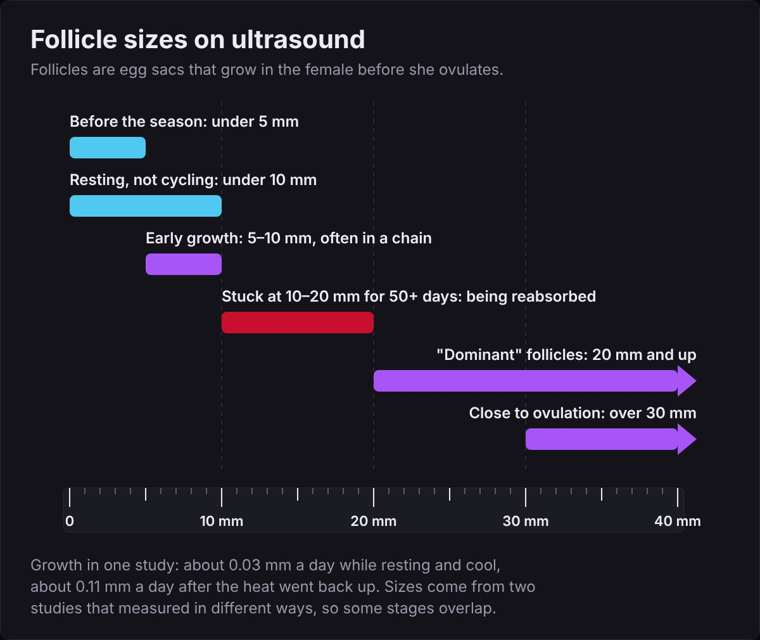
Follicle sizes (two studies, different methods):
| Stage | Size | Source |
|---|---|---|
| Resting (not cycling) | under 10 mm | [3] |
| Before the season | under 5 mm | [1] |
| Early growth, after the cool period ends | 5–10 mm, often in a chain | [1] |
| "Dominant" follicles | 20 mm and up | [3] |
| Advanced, approaching ovulation | over 30 mm | [1] |
Growth rate. In the study, follicles grew slowly, about 0.03 mm a day, while the female was resting and through the cool period. After the heat was turned back up, they grew faster, about 0.11 mm a day, until pairing [1]. Ovulation itself couldn't be pinned down reliably by ultrasound [1].
Palpation
Gently running a hand along the lower belly can find follicles as firm "grapes." It works, but it misses a lot: in one ball python study palpation found growing follicles 75% of the time compared with ultrasound [4]; in another snake species (the Louisiana pinesnake) it found them in only 40% of females at the stage before ovulation and 80% around ovulation [5]. Use it as a rough check, not a timer.
Follicles that stall (atresia)
Not every female that starts follicles finishes. In the follicle-cycle study, some follicles grew past 10 mm, then stopped before 20 mm. When they stayed stuck for 50 days or more, the body was taking them back in [3]. A female who stalls isn't sick; she's skipping. Pull the male, feed her back up, and try next season.
A different problem is preovulatory follicular stasis: follicles that stay large and neither ovulate nor shrink. It's treated by a vet, often surgically [6]. A female with a swollen lower body who isn't moving toward ovulation should see one.
Step by step
Tracking follicles through the season:
- Once the season starts, check for follicles. Use an ultrasound if you can, and palpation only as a rough check.
- To scan: no sedation, plenty of gel, snake belly down and lifted a little, probe across the body over the middle and back third. It takes about 5 minutes.
- Once follicles show, scan every 2 to 3 weeks and write the sizes on her card (our plan).
- Use the sizes to time introductions (see Introductions and locks).
- When follicles pass 30 mm, ovulation is getting close (see Ovulation to laying).
- If follicles stall under 20 mm by March, take the male out. She tries again next year (our plan).
- If follicles stay large and don't ovulate or shrink, see a vet.
Sources for this chapter
- Bertocchi, M. et al. (2018), PLOS ONE 13(6): e0199377, repository PDF
- MorphMarket Community, Tips for ultrasounding ball pythons (keeper forum)
- Journal of Herpetological Medicine and Surgery 26(3–4): 108–116 (2016), Evaluation of the follicular cycle in ball pythons
- University of Pisa veterinary thesis (2024), 48 females (abstract), etd.adm.unipi.it
- Oliveri, M. et al. (2022), ultrasound and palpation in Louisiana pinesnakes, Animals 12: 2983, MDPI
- MSD Veterinary Manual, Reproductive diseases of reptiles